"Traffic-Smoothing" & Bilateral Distancing Mode
Summary
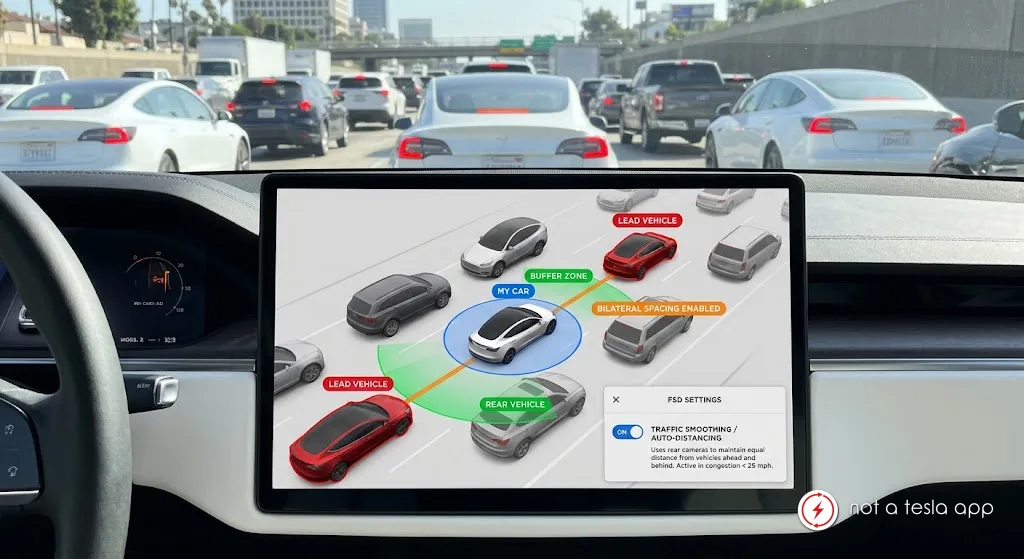
A proposed FSD mode using bilateral distancing to smooth stop-and-go traffic and end jams.
How It Would Work
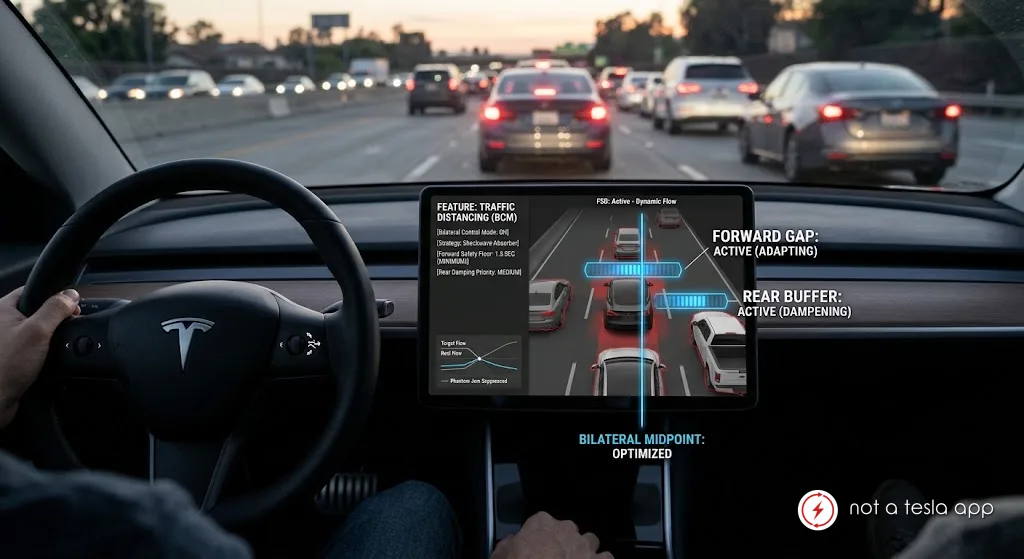
Traffic jams often start without an actual bottleneck. A single driver tapping their brakes causes trailing drivers to brake harder, triggering a backward-traveling "phantom traffic jam." The Traffic-Smoothing / Bilateral Control FSD Mode turns a Tesla into an automated damper, absorbing these shockwaves to keep traffic moving steadily.
1. Dual-Sensor Tracking (Front & Rear)
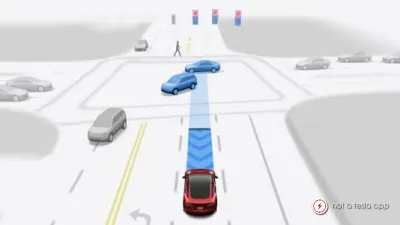
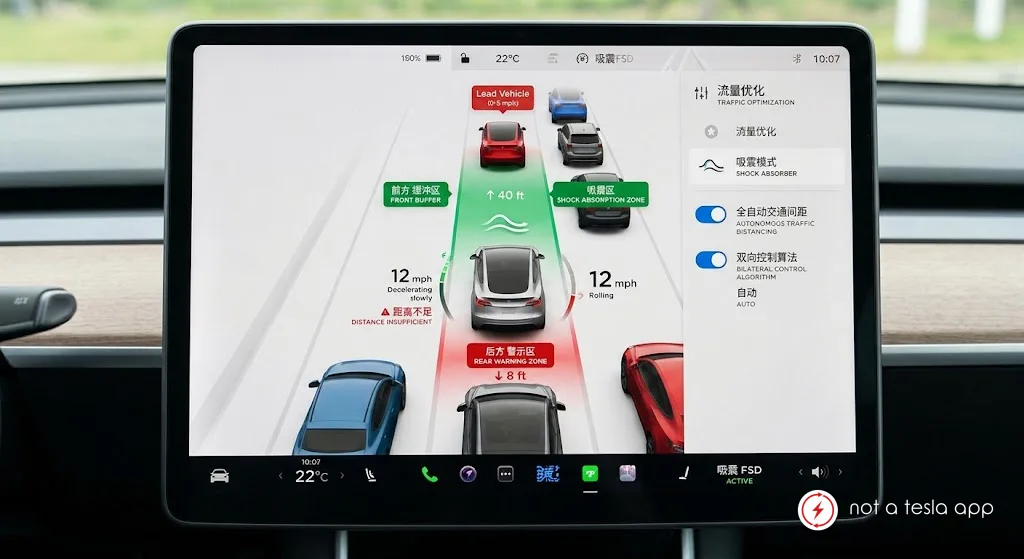
Standard FSD focuses primarily on the path ahead. In Traffic-Smoothing mode, FSD tracks both the preceding vehicle and the trailing vehicle simultaneously via rear and forward cameras. It calculates a real-time target position centered exactly between them.
2. Rolling Speed Prioritization (Low-Pass Filter)
Instead of accelerating rapidly to close gaps and then braking to a dead stop, FSD looks 300–500 meters ahead. When forward traffic halts, FSD uses regenerative braking early to slowly decay speed (e.g., maintaining 8–10 mph). This holds off a full stop long enough for the queue ahead to start moving again, eliminating unnecessary stop-and-go cycles.
3.Bilateral Shock Absorption
If the front car brakes suddenly, FSD checks the tailgating distance behind. If safe, it delays hard braking and lets the forward gap shrink temporarily. This gives the trailing driver extra seconds to react smoothly, preventing them from slamming their brakes and passing the shockwave downstream.
4. Adaptive Creep & Cut-In Management
To handle cut-ins from adjacent lanes:
0–15 mph: Tightens the gap to 1.5–2 car lengths with a steady creep to discourage cut-ins.
15–35 mph: Expands the buffer to 3–5 car lengths to maximize shock absorption.
Multi-Vehicle & V2X Capabilities:
V2V Swarm Platooning: Connects surrounding FSD vehicles over localized networks to synchronize rolling speeds across multi-lane queues.
Multi-Car Vision Chaining: Tracks brake lights and movement up to 3 cars ahead to react preemptively to upstream deceleration events.
Cooperative Merging: Dynamically coordinates gaps with neighboring vehicles to allow smooth lane changes without triggering sudden hard-braking events.
5. Safety Boundaries
Forward Safety Floor: Collision avoidance always overrides rear spacing; if the front gap hits a critical minimum threshold, the car brakes immediately regardless of trailing distance.
Brake Light Suppression: Prioritizes smooth regenerative braking to keep trailing drivers from panicking.
Why It Works
Traffic modeling shows that if just 5% to 10% of vehicles on a highway run a bilateral smoothing algorithm, phantom traffic waves collapse completely—improving energy efficiency, reducing rear-end crash risks, and easing gridlock for everyone on the road.
Vote for this feature
The top three requests at the end of the month will be shared with Tesla.