In a revelation that surprises no one, Tesla is working on wireless charging. The company bought a wireless charging company, then sold that company and kept all the engineers. It also hinted at wireless technology during Investor Day in March. However, we now have official confirmation from Tesla.
Franz von Holzhausen's Confirmation
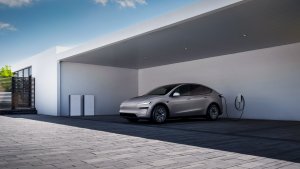
Tesla's wireless EV charging development was officially confirmed in a recent interview with Jay Leno (below). Franz von Holzhausen, Tesla's Chief Designer, explained the project: "Oh, we’re working on the inductive charging. So you don’t need to plug something in at that point. You just pull in your garage, drive over the pad, and you’re charging."
While wireless charging is not new to the EV industry, Tesla's entry into this realm is noteworthy. Several companies, including WAVE and Plugless Power, have explored wireless charging for EVs. However, Tesla's involvement is expected to accelerate the technology's development and adoption.
While only home charging is being considered, the technology could translate to road charging, which now has a pilot program set up in Detroit. The technology behind this advancement involves rubber-coated copper coils embedded beneath the road surface. These coils enable charging for EVs equipped with specialized receivers. The project, a collaboration between the Michigan Department of Transportation, Electreon, and other partners, is limited to vehicles with specific receivers, this technology paves the way for broader applications and integration into the existing EV ecosystem.
Despite the promise of convenience, wireless charging faces challenges, particularly regarding energy efficiency. Converting electricity into a magnetic field and back incurs energy losses, raising concerns about the technology's efficiency compared to traditional plug-in methods. Nevertheless, early reports suggest that Tesla's wireless chargers exhibit remarkable efficiency, potentially addressing these concerns.
The Genesis of the Wireless Charging Concept
Further highlighting Tesla's innovative approach, Rebecca Tinucci, Tesla's Senior Director of Charging Infrastructure, recently named Time Magazine’s Top 100 Most Influential Climate Leaders, provided an insightful comment during an Investor Day 2023. With a slide that read Can't Forget to Do Cool S***, she said, "We are Tesla, so we also want to make sure we are continuing to focus on providing really incredible charging experiences." This remark underscored Tesla's commitment to enhancing the EV charging experience, and the slide also showed a Model S parked with what appears to be a charging pad under it.
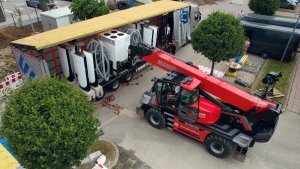
Tesla's pursuit of this technology was further evidenced by its acquisition and subsequent sale of Wiferion, a European company specializing in wireless EV charging. This strategic move, often called acqui-hiring, allowed Tesla to integrate key Wiferion engineers into its team while divesting the rest of the company.
Introducing wireless charging technology involves significant installation considerations, including the cost and the need for an inductive receiver on the vehicle. Despite these factors, Tesla's move towards wireless charging aligns with the company's vision of a seamless, automated charging solution, especially in the context of self-driving technology. The vision is to one day have cars that drive themselves; now, they may charge themselves, too.