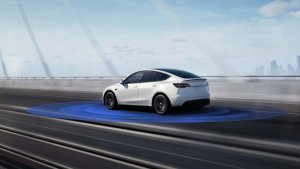
Tesla recently started rolling out an update that enabled the cabin radar in recent Model Ys and added support for first-row cabin sensing. This functionality not only lets Tesla replace the seat occupancy sensors in the front seats but also gives them a better idea of the size of the passengers — critical information when an accident occurs.
However, Tesla has now revealed that it won’t just be recent versions of Model Y that will receive these updates. Other recent vehicles also have a dormant in-cabin radar that will be activated in a future update.
Child Presence Detection
This front-row occupant sensing is only half of the update. Tesla also plans to add support to the rear seats that will let it detect occupants left in the vehicle. In a post on X, Tesla stated that at least 37 children die per year from heatstroke, just in the United States, according to the NHTSA. Tesla’s cabin radar will help reduce the number of deaths by detecting children left in the vehicle and alerting the owner or turning on the HVAC system.
The new radar has several safety-focused features, and they’re all designed to help protect someone left behind in a vehicle. First up - the radar will detect and classify passenger sizes to determine which airbags to deploy dynamically, helping to reduce injuries from shorter individuals sitting up front.
Additionally, the radar can differentiate an adult from a child or baby - and automatically and dynamically make the necessary safety adjustments on the fly. Tesla will also be able to detect heart rate and breathing through the radar - and has a series of safety steps it can take from here.
If a child or baby is detected being left behind in the vehicle, the Tesla app will immediately notify you and turn on the HVAC system to ensure their safety. In the case of an emergency, the vehicle will automatically call emergency services and report its location.
As a reminder, while Tesla vehicles outside of the United States support eCall, vehicles within the US cannot call 911 unless a phone is connected to the vehicle via Bluetooth. We hope that Tesla looks to add similar capabilities in North America to improve safety capabilities.
Supported Models
Although the cabin radar has only been activated in Model Ys produced in the last couple of years, Tesla said in their post on X that the radar is also available in recent Model 3s and the Cybertruck.
We did a little digging and confirmed that the part numbers for the cabin radar are the same for the 2024+ Model Y, 2024+ (new) Model 3, and the Cybertruck. So, these vehicles should also receive the latest cabin radar features.
Although the 2023 Model Y features a different part number, 2022 and 2023 Model Ys have also been receiving the front-row cabin sensing feature in Tesla’s 2025.2.6 update, but it is less clear whether they’ll receive the rear seats update later this year. The Model S and Model X also include a cabin radar, but the part number also differs from the cabin radar for the 2024 Model 3 and Model Y.
While the new Model Y isn’t available to check against on Tesla’s Electronic Parts Catalog, it looks like Tesla has been shipping the new 4D cabin radar in at least the 2024+ versions of their Model 3, Model Y and Cybertruck.
We expect rear-seat sensing to arrive on vehicles with the latest cabin radar later this year, while it’s unclear whether the other vehicles with the older cabin radar will receive it.
Tesla mentioned that rear-seat support will arrive in Q3 2025 for the refreshed Model Y. Based on the different interior sizes and spaces, sensor calibration and testing for other models may come slightly later.
Hopefully, the upcoming refresh for the Model S and Model X will also be able to receive this update later this year.