It was a rainy April 1st when a news-searching author went on a delve into the depths of April Fools to find fact from falsehood. And while we found a lot of fantastic jokes, we also found some good ideas.
So, with a shoutout to MarcoRP on X, whose April Fool’s Joke gave us a good run for our money for a couple of minutes, we thought to ourselves - what would a Cybercab Charging Station / Cleaning Hub really look like?
Cybercab Wireless Charging Sites
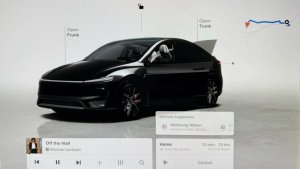
Now, before continuing, we’d like to point out that the image up top is a joke from Marco - it isn’t an accurate or real site map submission from Tesla. However, it gave us the impetus to think critically about what is required for a Robotaxi fleet, based primarily on the Cybercab, to be able to service a city.
Requirements
Tesla will likely need to charge a small fleet of Cybercabs at a single time and in a single place. That means that the site needs to be large enough to cover a major metro area while also still being compact enough to not cost too much money to build out.
In addition, we need to factor in charge times. The Cybercab is likely to launch with a battery around 50 kWh, which will result in a range of approximately 300 miles. With that much range, the average Cybercab may not need to charge more than once or at all during daytime shifts, so instead, most of the vehicles will charge overnight.

Math and Charge Times
The overnight charging means that most of these vehicles could be charged slowly. When we did some back-of-the-napkin math last year, we determined that Tesla’s wireless charger will likely peak around 17 kW (for comparison, Tesla’s Wall Connector at 32 amps charges at about 7 kW). If we scale Tesla’s wireless charger down slightly to 10 kW, accounting for some energy loss and the potential size of the site, that means a Cybercab will be able to charge in about 5 hours.
Tesla’s upcoming V4 Supercharger unit can currently handle 1.5MW per cabinet, but this slower-speed charging is A/C, not DC, which means there is a step-down loss of about 3-5%. Let’s make that a comfortable 10% for any other overages, but we can estimate around 1.35MW of power. That 1.3MW will easily handle charging up to 100 Cybercabs at once - all wirelessly, using Tesla’s unique beam-forming and beam-steering technology to keep efficiency high at every single stall.
Within about 5 hours, a whole fleet of 100 Cybercabs could be charged overnight when electricity rates are cheaper and still be out in time for the morning commute.
While this is all just hypothetical, it really does make sense that Tesla will be establishing these sites that won’t require much space or a ton of energy.
Tesla recently curtained off a large section of the parking garage at Giga Texas, as well as some of their chargers on the eastern end of the facility, leading us to believe they may just be testing this at scale internally.
There’s a lot to look forward to with Tesla’s V4 Supercharger deployment coming this year and with Robotaxi launching in just a couple of months.