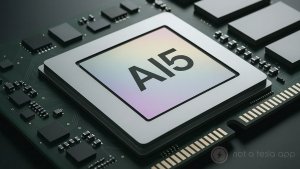
While we haven’t even seen AI5, Tesla is already thinking about its next set of chips that will power Tesla’s future FSD computers. In a set of posts on X, Elon Musk outlined the future of Tesla’s AI hardware, stating that its “strategic importance is hard to overstate.” He also revealed that Samsung, the current manufacturer of Tesla’s AI4 chip, will produce the next-generation AI6 chip at a new, dedicated fabrication facility in Texas.
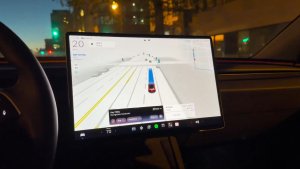
While AI4 is already used in Tesla’s Robotaxis, which are practically driving autonomously, it’s hard to imagine where the company will be with a computer that’s many more times as powerful. Things like the recent video of a Tesla stopping at a toll booth, waiting for the driver to pay, and then taking off will become commonplace, not only at booths but also in various nuanced scenarios, such as someone waving you by, or stopping for a friendly neighbor that waves you down.
Samsung’s giant new Texas fab will be dedicated to making Tesla’s next-generation AI6 chip. The strategic importance of this is hard to overstate.
— Elon Musk (@elonmusk) July 28, 2025
Samsung currently makes AI4.
TSMC will make AI5, which just finished design, initially in Taiwan and then Arizona.
The Current Two-Language Problem
To understand the need and brilliance behind why Tesla is doing what it's doing with AI6, we need to take a look at the problem it is being engineered to eliminate. Currently, Tesla, like many others, faces a real two-language problem in its AI development.
The vast majority of its AI training is done on a supercomputer cluster, Cortex, which is built around Nvidia’s powerful H200 GPUs. However, the vehicles that run the software use Tesla’s custom-designed hardware - HW3/AI3 or HW4/AI4. This means that every time the AI model is improved - whether the vision neural nets or the ones that determine distance, or any of the many little parts that come together to build FSD as a whole - there’s a whole second step. It must be developed and validated on Nvidia’s architecture, then rebuilt and re-validated to run on Tesla’s own AI hardware.
Tesla runs AI4 chips side-by-side with the H200 GPUs in Cortex to minimize this, but that still means there is a step in between the training getting completed and the actual model being able to run on a vehicle. This slows down the feedback loop from training to deployment, even if Tesla has built a Universal Translator to help move FSD from one piece of hardware to another.
AI6 Solution: One Chip to Rule Them All
AI6 is the definitive solution to this problem. While the upcoming AI5 chip (to be made by TSMC) represents a performance leap over AI4, AI6 will be a transformative leap in architecture.
The key innovation of AI6 is the direct integration of Tesla’s Dojo Supercomputer chip architecture into the same hardware that will be in Tesla’s vehicles and Optimus. The goal is to closely integrate the training and vehicle hardware.
By having the same Dojo architecture in the data center for training and in the vehicle for inference, Tesla will have a single, unified hardware pipeline. The two-language problem vanishes, drastically simplifying Tesla’s development process and enabling a much faster pace of innovation and updates.
Manufacturing Collaboration
The plan for AI6 goes beyond just chip design. Elon’s announcement revealed that Tesla plans to build a strong manufacturing partnership with Samsung. After all, much of Tesla’s expertise is focused on the machines that build the machines.
Samsung has agreed to allow Tesla to assist in maximizing manufacturing efficiency at the new Texas fab. It’s unusual to see this kind of relationship between the fabricator and the client. Elon doubled down on this - he wants to walk the fab lines to personally accelerate the pace of progress.
Samsung agreed to allow Tesla to assist in maximizing manufacturing efficiency.
— Elon Musk (@elonmusk) July 28, 2025
This is a critical point, as I will walk the line personally to accelerate the pace of progress. And the fab is conveniently located not far from my house 😃
Tesla isn’t just designing the chip, but helping to make sure it’s made in the most efficient and optimal way possible, all while leveraging Tesla’s experience and Samsung’s fab skills in one facility.
Fully Integrated
Tesla’s AI6 announcements come as a surprise since Tesla is still a year out from releasing AI5, but it shows that Tesla plans to integrate even more of its AI stack. From influencing the manufacturing process of the chip itself to designing a unified hardware architecture for both training and inference, Tesla is building a self-reinforcing ecosystem.
This approach will create a feedback loop that allows for rapid improvement. While AI5 will be a big step up from the current generation, AI6 is revolutionary as it becomes Tesla’s major AI platform.