While Tesla’s long-term AI hardware strategy is focused on the unified architecture of AI6, that’s still many years away. The road to that future is paved with iterative steps, but there’s no avoiding the progression between generations. Tesla has recently made several announcements that give us a clearer picture of what it plans to do next, with its HW5/ AI5 computer.
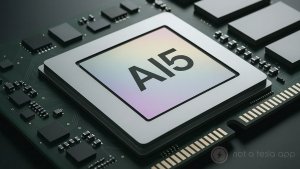
AI5 is Tesla’s next-gen FSD computer, which is expected to have a big performance boost over the current generation of AI4. While AI4 is already powering Tesla’s Robotaxi fleet, AI5 will power the Cybercab and will eventually be put into Tesla’s other models to provide a more capable and safer version of autonomy.
The difference in real-world performance between AI4 and AI5 is far more than any chip version I’ve ever heard of
Huge Performance Leap
The clearest thing we know about AI5 is its raw power. The new FSD computer is projected to be between 3 and 5 times more capable than the already powerful AI4 hardware that’s currently in production vehicles.
The hardware is expected to be capable of 2,000 to 2,500 TOPS (trillion operations per second. For comparison, some of Nvidia’s latest gaming GPUs, the RTX 5080 and the RTX 5090 (about $1,500 and $3,000 GPUs, respectively) are capable of 1,800 and 3,400 TOPS. However, those also come alongside significant power draws of 360 and 575 watts, likely more than Tesla is aiming for with AI5.
This additional performance will be crucial for enabling more complex neural networks, allowing the vehicle to process more data from its cameras and sensors at a faster rate. It will also be able to hold more contextual information in memory, which will help to further isolate and handle edge cases. We also expect a big jump in memory, as Tesla has already been running into constraints with AI4 due to available memory. The result is expected to be even quicker and more human-like decision-making, all while being safer and more capable.
While it’s clear that AI5 will be much more powerful than HW4, Elon recently gave us more information, stating that the real-world performance difference between AI4 and AI5 is far more than any chip he’s ever heard of. That’s the kind of statement that really makes you pause and think. Expect the jump from AI4 to AI5 to be much bigger than HW3 to AI4.
The difference in real-world performance between AI4 and AI5 is far more than any chip version I’ve ever heard of by a lot.
— Elon Musk (@elonmusk) August 8, 2025
It’s real good.
Manufacturing
For this generation, unlike with AI6, Tesla will be tapping TSMC, the world’s largest semiconductor manufacturer. According to Elon, the chip’s design was recently finalized, and the production plan involves a dual-location approach. The initial production will begin in Taiwan, with subsequent manufacturing to take place at TSMC’s new fab in Arizona. This approach secures access to the latest chip processes, while also building a path towards US-based production.
Release Date
Tesla and Elon have openly talked about AI5, initially saying that it’d be available in 12-18 months, which would have put it right at the end of this year. However, that timeline has now been pushed back. Tesla now plans to have AI5 in production and ready for consumer vehicles by late 2026 or even early 2027. With AI5 still more than a year out, there is still room for dates to shift, but now that Tesla has finalized its chip design, we don’t expect major changes.
First Use Case
Given that AI5 won’t be reaching mass production for at least another 14 to 18 months, what will Tesla be using the AI5 chips for in the meantime? For training and Cybercab, of course.
Tesla’s first recipient of AI5 will be the purpose-built Robotaxi, the Cybercab. A dedicated autonomous vehicle with no driver controls will require an immense level of computational power for additional safety and redundancy. The 3-5x performance jump offered by AI5 makes it a logical choice for the Cybercab’s, which is also slated to hit volume production sometime in 2026.
Should You Wait for AI5?
With news of such a big upgrade on the horizon, many potential buyers may wonder if it’s a mistake to purchase an HW4 vehicle today. In our eyes, the short answer is - no. The current HW4 hardware is already incredibly capable, and Tesla is actively using it for Robotaxi in Austin today. The current hardware is what FSD is being developed and validated for, for millions of vehicles, and is clearly designed to be Robotaxi-capable.
Even if Tesla releases AI5 in December of 2026, it would likely still be months before the first appreciable performance improvements make their way to AI5 vehicles. The divergence between HW3 and HW4 took months - and in fact, there was a period of time where HW4 vehicles didn’t even have access to FSD due to the hardware being too new and too sparse for training data to be collected.
For those still apprehensive about buying a vehicle before a major hardware shift, there’s always another solution. A 24-month lease on a new Tesla in 2025 provides a lower-commitment option that gets you in a capable vehicle today, and ends around the time AI5-equipped vehicles are expected to begin their mass rollout, offering a bit of a bridge between techs.
Of course, if you’re subscribing to the idea of always getting the latest hardware, well, AI6 is still far over the horizon, and there really is no better time than now.
Ultimately, AI5 is just another step forward in Tesla’s journey towards full autonomy, and it may actually be a step after Unsupervised FSD becomes a reality. It will be the brains that drive the Cybercab, as well as the crucial stepping stone for Tesla to begin their big shift towards their homegrown Dojo chips for AI6.