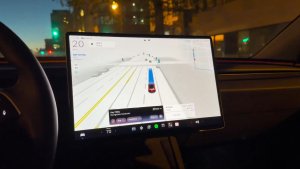
Tesla’s Robotaxi network officially went live in the San Francisco Bay Area on the night of July 30th, expanding the program outside of Texas for the first time. However, the launch revealed some major changes in the way Tesla operates the Robotaxi network when compared to the network in Austin.
The pricing structure in the Bay Area is vastly different. Now fares are priced more competitively against Uber and Waymo, while also operating under strict, regulator-defined restrictions, the Bay Area launch seems more of a cautious, safety-first rollout in comparison to the Austin Robotaxi network.
A New Pricing Model
The most immediate difference for those with early access is the price. While the Austin service was noted for being significantly cheaper than the competition, even with the recent dynamic pricing update, the Bay Area pricing is far more in line with existing ride-hailing services. One of the first documented rides, a 16-mile trip that took 26 minutes, cost $37.44. That works out to approximately $2.34/mi, which is in line with what one may pay for an Uber or Waymo in the same area.
In comparison, rides in Austin now cost about $1.25 per mile under the new pricing structure. The move to a higher price point is interesting and leads us to believe that Tesla expects to have a driver behind the wheel for some time in this area.

Supervised Experience: California Edition
The Bay Area pricing structure appears to be linked to the Robotaxi network’s operational reality in California. Due to the current regulatory framework, Tesla is calling this a “Supervised Ride Hailing Service”, rather than a full-blown Robotaxi Service, like in Austin.
In California, a human safety driver is sitting in the driver’s seat, and is required to keep their hands on/near the wheel during the entire ride. This is a far more stringent and hands-on requirement than the one in Austin, and if Tesla needs to keep a driver behind the wheel, it likely explains the fare that’s almost twice the price.
My first Tesla Robotaxi ride in the Bay Area, CA! 🔥 https://t.co/arZykKfNbZ
— Teslaconomics (@Teslaconomics) July 31, 2025
This launch follows a lengthy permitting process that Tesla began in California earlier this year. The company is clearly taking a pragmatic approach by complying with regulations, and the next step is waiting for the “hands-on” safety driver requirements to be waived.
Geofencing and Access
Tesla is taking full advantage of the driver behind the wheel. Instead of operating in a carefully marked geofenced area and blocking off complicated intersections, they’re covering a massive area. It spans approximately 65 miles from the north of San Francisco, and extends south of San Jose. While a good chunk of that area isn’t drivable, what is notable here is that the service is now able to use highways in the Bay Area, unlike Austin.
You can check out the geofence in our updated Robotaxi map below. The smaller, darker purple areas are Waymo’s network in San Francisco and Palo Alto, while the lighter purple is Tesla’s geofence in the Bay Area.
We’ll have to keep a close eye out to see whether highway support arrives in Austin in the coming days, or if Tesla is limiting it to the Bay Area due to the presence of a safety driver.
Tesla is also sending out a new round of invites to a limited group of users in the Bay Area. A significant perk for those invited is that they’ll have immediate access to both the Supervised Robotaxi in the Bay Area, as well as the more autonomous Robotaxi Network in Austin.
While the launch is a good step forward and a major milestone, the combination of competitive pricing and heavy supervision dampens the excitement somewhat. Is Tesla using this launch as a way to test how the Robotaxi would perform in much more complicated scenarios? By having a driver behind the wheel, that would certainly be a much safer way of doing that.
While this network in California differs drastically in supervision, pricing, and coverage area, we should soon find out if Tesla is using it as a testing ground for additional Robotaxi features that will be deployed in Austin in the future.