Tesla’s Autopark is a great feature, but it only works under certain conditions. The parking spots can’t be angled, and the vehicle will always back in. At Superchargers, this could be even more challenging due to the stalls and other vehicles nearby.
An owner recently posted on X about Tesla vehicles not parking reliably at Superchargers, arguably when the best places to use the feature. Musk responded, saying that it will “work essentially perfectly” with a future update.
Short Comings
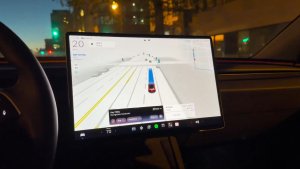
This is a welcome commitment to fixing a common frustration. While vision-based Autopark is leagues better than its previous rendition, there is still a lot to improve. Currently, the vehicle can only back into a parking spot or park in a parallel space, which admittedly is more difficult. However, the car simply won’t pull front-first into a parking space with the Autopark feature. It’s also noticeably slower than a human driver, making it practically unusable in busy areas where someone may be waiting for you to finish parking.
However, a lot of this may be about to change.
Parking is a foundational requirement for Robotaxi and Tesla’s entire future of automated charging. With owners soon getting a new FSD update that will incorporate many of the additions that the Robotaxi has received, it appears that FSD may not be the only improvement owners will receive.
Let’s take a look at Tesla’s automated charging solution in the future, which they may already be working on.
Yeah, it will work essentially perfectly with future software updates
— Elon Musk (@elonmusk) August 12, 2025
Better Autopark is a Prerequisite for the Future
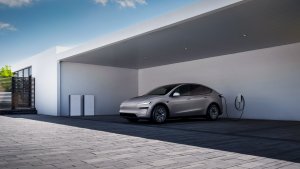
The ultimate goal for Tesla is a completely seamless energy experience, and that will eventually include hands-free charging. To achieve this, Tesla has been working on their wireless charging plans, including eventually upgrading some V4 Supercharger sites with induction wireless charging pads.
The Cybercab, Tesla’s dedicated Robotaxi, will only be charged wirelessly, so Tesla will have to build an even smarter and more precise version of Autopark than what exists today to use this functionality better. While the only other vehicle in Tesla’s lineup with the connectors (but not the receiver) for wireless charging is the Cybertruck, Tesla will eventually expand the feature out to more of its lineup once its plans for wireless charging are more firmed up.
However, for wireless charging to function, a vehicle can’t just park “close enough”. Inductive charging, especially at the speeds required to fast-charge an electric vehicle, is no game of horseshoes. Vehicles must be positioned with absolute, millimeter-level precision, every single time. An essentially perfect Autopark, as Elon mentions, is not a luxury but a necessity to enable Tesla’s future autonomy ambitions.
In the meantime, while we wait for Tesla to roll out wireless charging capabilities, owners should be able to plug their vehicles in easily.
Solving Today’s Problems
Before a vehicle can dock itself over a wireless charger, Tesla must solve the real-world problems that drivers face today. The current system’s inconsistency is well-documented, and there are several issues.
Vision-based Autopark can be extraordinarily precise, but it can also often be wrong. John Kraus, who asked the question that Elon answered, reported a 1 in 5 success rate with Autopark at Superchargers.
There are a few issues here - sometimes Autopark can miss the lines, or, more frustratingly, won’t back up far enough for the older and shorter V2 or V3 Supercharger cables to reach. If you’re driving a Cybertruck, that problem is exacerbated even further, as you often have to get in extremely close with the Supercharger post on older sites due to the length of the truck, which Autopark is just unable to do.
Handling Queuing Smartly
With Tesla also set to enable Virtual Queuing support for busy Supercharger sites in the near future, there’s no better time than now for them to double down on Supercharger parking support. It would make the entire experience far more seamless if your vehicle simply joined the Supercharger Queue automatically, waited for its turn, and then automatically parked itself into the correct stall.
All you have to do at that point is hop out and plug the cable in (for now), which really makes the entire experience into something that no one but Tesla can build.
The promise to make Autopark perfect is a good response to current owner frustrations, but there’s clearly a lot more that’s driving this promise behind the scenes. Perfecting Autopark will be essential for autonomy and will be a key step to automated, hands-free charging in the future.