On stages across the world, he is the quiet, constant presence next to Elon Musk, letting his design work do the talking. Yet, his influence is profound, especially in the work he has created.
Franz von Holzhausen is the man who has crafted the entire visual identity of the modern electric vehicle. From the sleek, elegant lines of the timeless Model S, which proved that electric vehicles can be beautiful, to the brutalistic, rule-breaking, sharp angles of the Cybertruck, Franz’s pen has forced a century-old industry to change course.
This is the story of the man who designed the future.
Forged in Legacy
Born in Simsbury, Connecticut, to an industrial designer father, Franz von Holzhausen was immersed in the world of design from a young age. He followed this passion to the prestigious ArtCenter College of Design in Pasadena, California, a legendary institution that has produced some of the world’s most influential automotive designers. After graduating in 1992, he began a career that would see him rise through the ranks of some of the most prominent names in the automotive industry.
Concept One

His first major role was at Volkswagen, where he was part of the team that designed “Concept One,” the project that would become the iconic Volkswagen New Beetle. It was a stunning success that blended retro nostalgia with modern design, setting the tone for Franz’s career of culturally significant and iconic vehicles.
Not a Tesla Roadster

In 2000, he joined General Motors, where, as a design manager, he was responsible for two of the most stylish American vehicles that defined sports car design for the next decade: the Pontiac Solstice and the Saturn Sky roadsters. These two vehicles were praised for their athletic proportions and beautiful surfacing, proving his ability to create designs that people fell in love with at first sight.
To Flow Like Water

His final stop before joining Tesla was as the Director of Design at Mazda North America. From 2005 to 2008, he led the development of the brand’s influential Nagare, or Flow, design language. This was showcased in a series of breathtaking concept vehicles like the Kabura and Furai, which won accolades across the auto show circuit and helped cement Franz’s name in the industry as a true visionary. He was the cream of the crop — the designer that everyone wanted on their team for inspiration and new model design.
A Leap of Faith

In 2008, Franz made a decision that many saw as career suicide. He left his high-paying position with Mazda as well as the entire legacy auto industry as a whole. He joined a tiny, struggling startup called Tesla Motors, which had so far only produced a low-volume sports car based on a Lotus. They had no vehicle design program, no studios, and little to no budget.
Franz was personally recruited by Elon Musk for a monumental task: to build an entire design studio and build a new brand identity from a completely blank slate.
This was Franz’s chance of a lifetime. He was drawn to the mission of proving that electric cars didn’t have to be compromises. They didn’t need to look like a bulbous Bolt or a pretentious Prius - instead, they could be the best, most beautiful, and most desirable cars on the road, period. Without the constraints of brand history or legacy platform, he had the freedom to finally design the vehicles he wanted, as he wanted, from scratch.
Building Tesla’s DNA: S3XY

The first fruit of that labor was the Model S. When it was unveiled, it took the design world by storm. With its clean, powerful lines, muscular haunches, and the complete absence of a traditional grill, it looked like nothing else on the road.
It was an elegant, timeless, and effortlessly futuristic design that continues to turn heads over a decade later. Inside, the massive central touchscreen removed dozens of physical buttons, creating a minimalist, yet highly functional space that would define the interior of every Tesla and the entire auto industry. The Model S is the car that finally made the world take EVs seriously.
No longer was the EV the vehicle chosen only by the climate hippie or the ultra-rich as a toy. Instead, it became a vehicle that the average luxury car shopper could afford and wanted to purchase. Soon, the Supercharger Network’s expansion across the North American continent enabled the Model S to travel almost anywhere.

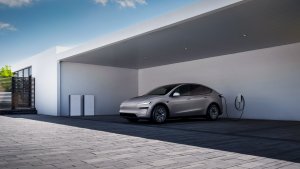
Following the massive success of the Model S, as well as the iconic falcon-wing door Model X, Franz faced his next great design challenge. Democratizing the design for the mass-market Model 3 and Model Y.
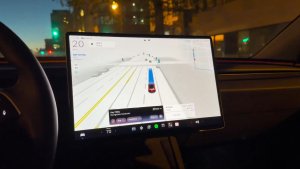
His goal was to retain the premium Tesla aesthetic in a car that was far cheaper and easier to manufacture than the Model S or Model X. Tesla perfected the minimalist interior by removing the traditional instrument cluster entirely, instead focusing all attention on the vehicle’s singular display. The design was entirely unheard of — and yet it worked. The Model Y went on to become the world’s best-selling vehicle multiple years in a row as people fell in love with both the interior and exterior.

Shattering the Mold: the Cybertruck
If the Model S, 3, X, and Y wrote the rules of Tesla’s car design, the Cybertruck was created to shatter that illusion. Franz never played by the rules throughout his career, so maybe Tesla shouldn’t either. Applying a pure first-principles approach, Franz and his team rejected every established pickup design notion. The vehicle’s form was dictated entirely by its function and unconventional material.

The nearly impenetrable stainless steel exoskeleton could not be stamped like traditional car panels. Instead, the result was a brutalist, apocalyptic, and unapologetic design of flat planes and sharp angles that looked like it had driven right out of a science fiction film. Some criticize the look of the Cybertruck as being visually off-putting, or reminiscent of a dumpster even, but even its critics can’t deny that it is unique, memorable, and instantly recognizable.
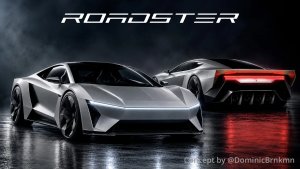
The Cybertruck was, and remains, one of the most polarizing and instantly recognizable vehicle designs in history. This philosophy of rethinking every category has extended across Franz’s work on the hyper-efficient Tesla Semi and the impossibly sleek next-generation Roadster. His portfolio at Tesla isn’t just a series of cars. It is a timeline of statements about the future.