In a validation of Tesla’s integrated and intelligent security systems, a new study from the independent Insurance Institute for Highway Safety (IIHS) has revealed that the Model 3 and Model Y are the least likely vehicles to be stolen in the United States.
The data essentially confirms the effectiveness of Tesla’s Sentry Mode and live camera viewing to deter thieves. The report found that electric vehicles in general are 85% less likely to be stolen than the industry average, and Tesla leads that pack by a massive margin.
A League of Its Own
The IIHS data on whole-vehicle theft claims is fairly cut and dry. The report uses a relative claim frequency, where a score of 100 represents the average for all vehicles. Tesla’s scores are so low that they are in a category by themselves.
The Model 3 and Model Y are ranked number one and two, with an incredibly low relative claim frequency of just 1 and 2. The Model S came in fifth with a score of 5, likely due to its higher value.
To put that into perspective, the most stolen vehicle, the Chevrolet Camaro ZL1, had a relative claim frequency of 3,949. That means a Camaro is nearly 4,000 times more likely to be the subject of a vehicle theft claim than a Model 3.
The Digital Fortress
This isn’t just by luck; it’s all by design. Every Tesla is protected by a series of integrated features that work together to help deter thieves and to track down or disable the vehicle in the event it is stolen, but it goes far beyond just Sentry Mode.
The foundational feature here is that every Tesla is always connected. A constant cellular connection allows the owner to track the car’s precise GPS location in real-time through the Tesla app, which can be relayed to police in the event of the vehicle ever being stolen.
Combine this with app control, and you can slow down the vehicle to a max speed of 50 mph. You can also lock your belongings in the glovebox and remotely look inside the vehicle with live camera viewing. You can even enable Valet Mode to reduce access to personal information.
Plus, remote notifications in the event of an incident are invaluable.
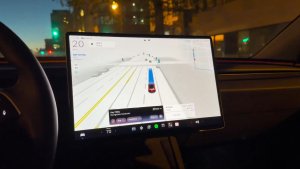
When you pair these with Sentry Mode as a deterrent, you’ve got an unbeatable combination. Using your vehicle’s cameras that are normally used for safety, Autopilot, and FSD, you can monitor your vehicle’s surroundings, and if a threat is detected, your vehicle will flash the lights, display a warning on the screen, and record, all while informing you.
Finally, if you’re being extra cautious, you can enable PIN to Drive. This is your final, but simplest level of security. An optional four-digit pin that must be entered in the vehicle before every drive can deter even those who make it past Sentry Mode. Without the code, your car is nothing more than a big, easily traceable brick.
The Results
The least stolen vehicles according to IIHS:
Vehicle | Relative claim frequency (100 = avg) | |
|---|---|---|
Tesla Model 3 AWD | Midsize luxury car (electric) | 1 |
Tesla Model Y AWD | Midsize luxury SUV (electric) | 2 |
Tesla Model 3 RWD | Midsize luxury car (electric) | 2 |
Toyota RAV4 Prime 4WD | Small SUV (plug-in hybrid) | 5 |
Tesla Model S 4WD | Large luxury car (electric) | 5 |
Volvo XC90 4WD | Midsize luxury SUV | 6 |
Volvo XC40 4WD | Small luxury SUV | 7 |
Ford Mustang Mach-E | Midsize SUV (electric) | 8 |
Volkswagen ID.4 | Midsize SUV (electric) | 9 |
Subaru Crosstrek 4WD with EyeSight (2024) | Small station wagon | 9 |
The worst offenders:
Vehicle | Relative claim frequency (100 = avg) | |
|---|---|---|
Chevrolet Camaro ZL1 | Large sports car | 3,949 |
Acura TLX 4WD | Large luxury car | 2,138 |
Chevrolet Camaro | Large sports car | 1,287 |
GMC Sierra 2500 crew cab 4WD | Very large pickup | 1,023 |
Acura TLX 2WD | Large luxury car | 805 |
GMC Sierra 3500 crew cab 4WD | Very large pickup | 742 |
Chevrolet Silverado 3500 crew cab 4WD | Very large pickup | 662 |
Dodge Durango 4WD | Large SUV | 592 |
Land Rover Range Rover 4WD | Large luxury SUV | 540 |
Ram 1500 crew cab short-wheelbase 4WD | Large pickup | 524 |
The Insurance Advantage
For years, Tesla owners have been frustrated by insurance premiums that often don’t seem to match the advanced safety and security features built right into every single Tesla. This definitive, data-backed report from a highly respected and independent organization like the IIHS provides insurers with the information they’ll need to evaluate their risk profiles.
Hopefully, in the near future, this data-backed security should lead to lower insurance premiums for Tesla owners. While the insurance industry is often slow to adapt, they’re greatly focused on data, and this data is what they need to justify increasing or decreasing premiums.
Thieves have already caught on—maybe it’s time insurers did too.