In the high-stakes race to solve autonomous driving, there’s a deep philosophical and engineering divide that has emerged over the years.
On one side stands virtually the entire automotive and tech industry, championing a concept called sensor fusion — a belt-and-suspenders approach that combines cameras, radar, and LiDAR to build a redundant, multi-layered view of the world.
On the other side stands Tesla, alone, making the bold and controversial bet on a single modality — pure, camera-based vision.
Tesla’s decision to actively remove and disable hardware like radar from its vehicles was met with widespread skepticism, but it was a move born from a deeply held, first-principles belief about the nature of intelligence, both artificial and natural. To understand just why Tesla took this bet, one must first understand what exactly Tesla rejected.
What is Sensor Fusion?
The concept of sensor fusion is fairly simple. It aims to leverage the unique strengths of different sensor types to create a single, unified, and highly robust model of the environment around a vehicle. Each sensor type has its own advantages and disadvantages, and, in theory, fusing them mitigates each type’s individual weaknesses.
Cameras provide the richest, highest-resolution data, seeing the world in color and texture much as a human does. They can read text on signs, identify the color of a traffic light, and understand complex visual context. Their primary weakness is that they can be degraded by adverse weather and low-light conditions, and they struggle to measure relative velocity.
Radar is excellent at measuring the distance and velocity of objects, even in terrible weather. It can “see” through rain, fog, and snow with ease, but its weakness lies in its lower resolution. No matter how you do the math, it would take a 12-foot by 12-foot square radar array that would cost millions to have the same resolution as a single camera, in a singular direction. It is good at telling you that something is there and how fast it's moving - as long as it is moving - but it struggles to identify what something is, and struggles to identify objects at a standstill.
LiDAR operates like radar but uses lasers, creating a precise 3D point cloud map of the environment. It is highly accurate in measuring distance and shape, enabling it to construct a highly detailed 3D model of the environment. Its primary weaknesses are its high relative sensor cost and its performance degradation in adverse weather conditions, particularly fog, snow, and rain. LiDAR also has another weakness: the amount of data pulled in is so large that sorting through it requires immense computational effort for the first step alone.
This is the established industry approach, used by companies like Waymo and Cruise, to fuse data from all three, creating a system with built-in redundancy.
Where Tesla Started: A Multi-Sensor Approach
It’s a forgotten piece of history for many, but Tesla did not start with a vision-only approach. Early Autopilot systems, from their launch through 2021, were equipped with both cameras and a forward-facing radar unit, supplied by companies specializing in automotive sensors, like Bosch. This was a conventional sensor-fusion setup, in which the radar served as the primary sensor for measuring the distance and speed of the vehicle ahead, enabling features such as Traffic-Aware Cruise Control and early iterations of FSD Beta.
This multi-sensor approach was the standard for years. Even as Tesla developed its own custom FSD hardware, the assumption was that radar would remain a key component, a safety net for the burgeoning vision system. Then, in 2021, Tesla made a radical pivot.
The Pivot: Why Tesla Abandoned Radar
The shift began in the summer of 2021, when Tesla announced it would remove the radar from new Model 3 and Model Y vehicles and transition to a camera-only system called Tesla Vision. The move was driven by a core, first-principles argument from Elon Musk about the dangers of conflicting sensor data - an argument he continues to make today.
Lidar and radar reduce safety due to sensor contention. If lidars/radars disagree with cameras, which one wins?
— Elon Musk (@elonmusk) August 25, 2025
This sensor ambiguity causes increased, not decreased, risk. That’s why Waymos can’t drive on highways.
We turned off the radars in Teslas to increase safety.…
Elon’s argument is that sensor fusion creates a new, more dangerous problem: Sensor Contention.
When two different sensor systems provide conflicting information, which one does the car trust? Which sensor is considered the “more precise” or “safer” sensor? Is it up to the car in the moment? Is it something decided by the engineers in advance? Sensor ambiguity poses a risk because the decision-making element can be paralyzing, especially when safety is prioritized.
This isn’t just a philosophical argument, either, and Tesla’s FSD engineers have provided concrete examples. In the same thread, Tesla AI Engineer Yun-Ta Tsai noted that radar has fundamental weaknesses - it cannot properly differentiate stationary objects that cannot produce frequency shifts, objects with thin cross-sections, or objects with low radar reflectivity. This is the source of the infamous phantom braking events that plagued Tesla in the past, where a car might see a stationary overpass or discarded aluminum can on the roadside and mistake it for a stopped vehicle, causing it to brake unnecessarily.
From Tesla’s perspective, the road to a generalized solution to vehicle autonomy is to solve vision. Humans drive with two biological cameras and a powerful neural network. The bet here is that if you can make computer vision work perfectly, any other sensor is, at best, a distraction, and at worst, a source of dangerous ambiguity.
Where We Are Today: The Vision on Vision
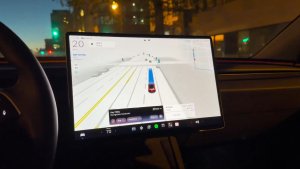
Today, every new Tesla relies solely on Tesla Vision, powered by its eight cameras. The system uses a sophisticated neural network to create a 3D vector-space representation of the world, which the car then analyzes and navigates within.
The story about vision has a curious footnote. When Tesla launched its Hardware 4 (now AI4), the new Model S and Model X vehicles were equipped with a new, high-definition radar. However, in a move that solidified their commitment to the vision-only path, Tesla has never activated these radars for use in FSD.
In fact, FSD is actually the most evolved on the Model Y, Tesla’s most ubiquitous vehicle, rather than the ones with the additional sensors. While Tesla likely does gather some data from those radars and validates system performance, they aren’t actually part of the FSD suite.
A Binary Outcome
Tesla’s decision to abandon sensor fusion is the biggest single differentiator between its approach to autonomy and that of the rest of the industry. It is a high-stakes, all-or-nothing gamble, which they’re definitely winning so far.
Tesla, Elon, Ashok, and the Tesla AI team all believe that the only path to a scalable, general-purpose autonomous system that can navigate the world with human-like intelligence is to solve the problem of vision completely. If they are right, they will have created a system that is far cheaper and infinitely more scalable than the expensive, sensor-laden vehicles from competitors.
If they are wrong, they may eventually hit a performance ceiling that can only be overcome by those very sensors - but so far, we’ve seen neither hide nor hair of such a ceiling.
Today, Tesla is all-in on its vision-only system, and no one can deny its progress or capability.