Tesla’s latest software update, 2025.32.3, introduces a new safety feature that helps to improve vehicle safety, all done with a simple over-the-air update. The new Frontal Airbag System Enhancement will now use Tesla Vision to help anticipate an imminent crash and begin deploying safety systems earlier than traditional crash-sensing methods allow.
That’s a major change from today’s current reactive approach, which must wait for a physical impact before deploying airbags.
From Reactive to Proactive
For decades, vehicle airbag systems have been reactive safety systems, a form of last-resort, last-ditch attempt to keep the occupants safe. They rely on a network of physical accelerometers and pressure sensors embedded throughout the vehicle to detect the violent forces of a crash, but only after the impact has already begun. While it is still incredibly fast, this method is still fundamentally limited to reacting to an event that’s already in progress, wasting precious fractions of a second.
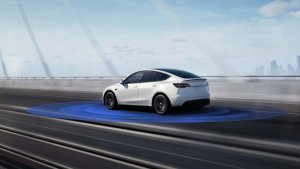
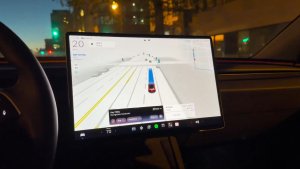
Tesla’s new system adds a powerful predictive layer on top of these traditional sensors. By leveraging the vehicle’s cameras and powerful FSD computer, the car can now see an unavoidable frontal collision fractions of a second before the moment of impact.
The key benefit is that this predictive capability enables the front airbags to begin inflating and safely restraining occupants earlier. These milliseconds of a head start can make a significant difference in safety outcomes by ensuring the airbag is in an optimal position to cushion an occupant at the precise moment of impact.
A Uniquely Tesla Advantage
Tesla also noted in the release notes that this proactive safety is something only Tesla’s integrated safety systems are capable of doing. This is possible because the same powerful computer and camera system used for FSD is deeply integrated with the car’s core safety hardware.
Unlike legacy automakers, which often source different electronic control units from multiple suppliers, Tesla’s vertically integrated architecture allows its vision system to directly influence its safety systems in real time.
This feature is a perfect example of Tesla’s philosophy of making your car safer and better over time, all done through software. A vehicle’s fundamental crash safety performance can now be improved with an over-the-air update, long after it has left the factory.
Rollout & Availability
This new feature is rolling out with software update 2025.32.3, however, it’s not available for every vehicle, at least not yet. This feature is being rolled out to newer Model 3s and Model Ys. From what we’ve seen, every Model 3 and Model Y that is 2023 or newer is receiving the feature, while some, likely late 2022 model year vehicles, are receiving it as well. The good news is that it doesn’t require HW4 or the AMD Ryzen MCU. There are plenty of vehicles with Intel and HW3 that are receiving this feature as well.
As Tesla validates its data on the high-volume Model 3/Y platform and gathers necessary data for other platforms, it’s possible we may see this added to the Model S and Model X, or even older vehicles.
This new proactive airbag system appears to be a great improvement in vehicle safety. It's more than just preventing crashes; it anticipates them and lessens the impact of unavoidable accidents— and the best part is, it’s completely free and comes as an OTA update.