The US National Highway Traffic Safety Administration (NHTSA) has announced that its plan to modernize the decades-old Federal Motor Vehicle Safety Standards (FMVSS) for autonomous vehicles (AVs) is finally in progress. While this is important for the entire industry, it’s a massive validation of Tesla’s long-held belief in vision-based autonomy.
For years, a major regulatory hurdle for Tesla has been the prescriptive nature of existing automotive safety rules, many of which were written in the 1960s for cars with human drivers and traditional features such as steering wheels. The new framework will start to move away from telling companies exactly what hardware to use and instead define how well their systems must perform.
While this will initially apply to features such as transmission features, wipers, and rearview and side mirrors, we expect it to expand into other areas as NHTSA modernizes its standards and switches to an “equivalent safety level” approach that’s based on performance in real-world tests.
The End of Prescriptive Rules
The traditional FMVSS created a potential roadblock for any company pursuing a novel approach to autonomy. The old rules were built around the assumption of a human driver and specific mandatory pieces of hardware, such as steering wheels, pedals, and mirrors. Innovators were faced with the challenge of either seeking individual exemptions or trying to fit their new technology into an old, outdated regulatory box.
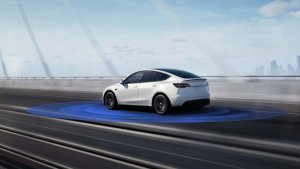
This has been particularly challenging for Tesla’s vision-only approach. While most of the industry has adopted a sensor fusion model using cameras, radar, and expensive LiDAR sensors, Tesla has chosen a vision-only model that mimics the human eye. It makes the system more generalized and scalable for autonomy. A prescriptive regulatory model could have one day mandated the inclusion of LiDAR or radar in vehicles, a move that could have prevented Tesla from offering FSD or autonomous vehicles in the future using their current hardware.
Performance over Hardware
The most important part of the NHTSA’s AV Framework for Tesla is the explicit shift to a performance-based standard. In a note from June, NHTSA stated that AVs can be exempt from fully complying with regulations, as long as they “demonstrate that their vehicles provide an equivalent safety level as compliant vehicles.” However, the manufacturer will be limited to 2,500 vehicles under this exemption as it’s currently written.
This change, along with the removal of requirements for mirrors, windshield wipers, and other items, has the NHTSA shifting to an approach that’s based on the performance of the vehicle, rather than specific hardware requirements such as reflective mirrors.
Instead of a rule that says “a self-driving car must have LiDAR,” the new rule would be closer to “a self-driving car must be able to detect a pedestrian at X distance under Y conditions, and come to a safe stop.”
Validating Vision Only
This new approach is a huge win for Tesla. It allows FSD to prove its safety and capabilities on its own merits, using its massive trove of real-world data from millions of vehicles. The system will be judged based on what it can actually do, not what and how many sensors it has.
This plays directly to Tesla’s strengths. They’ve long argued that Tesla Vision, powered by a sophisticated neural network trained on billions of miles of real-world driving, can eventually be safer than a human driver. The new NHTSA framework effectively clears the path for Tesla to make that case to regulators with data, without being handicapped by the requirements to include hardware that can create sensor contention and reduce safety.
While the full process of updating the federal safety standards will take years to complete, this announcement is a big moment for autonomy in the United States. It’s a sign that regulators are taking AVs seriously and creating a data-driven pathway for innovation.
Update: We’ve clarified this article and included the sources that this article is based on.
The first exemption under the updated FMVSS standards has already been granted, and it applies to ZOOX.