One of the most powerful yet least understood tools in Tesla’s autonomous driving development is Shadow Mode. Running code in shadow mode is a common software engineering method that lets a company test out new code in production without affecting the user.
For Tesla, it’s a core part of the data engine that allows FSD to learn and improve at an incredible scale. In short, FSD runs silently in the background on your Tesla, even when FSD isn’t enabled. The system will constantly make driving decisions without actually controlling the car.
This clever approach allows Tesla to gather an immense amount of real-world data, and it’s a key piece of the puzzle in the quest to solve autonomous driving. Let’s take a look at exactly what Shadow Mode is, how it works, and why it is so important.
What is Shadow Mode
The process behind Shadow Mode is both simple and brilliant. While a human is driving, FSD is also running silently in the background, as if it were in control. It receives the exact same inputs from the car’s cameras and sensors that it would if it were actively engaged, and based on this data, it makes hypothetical driving decisions.
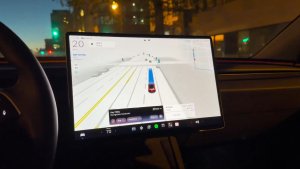
In fact, when you see on your screen FSD’s grey tentacle, that’s exactly what it is.
The crucial step and differentiator between active FSD and Shadow Mode is what happens next. These hypothetical decisions made by the AI aren’t executed, because after all, the human is driving. Instead, the system compares its decision with the driver’s decision and evaluates them. Wrong or different decisions can then be sent back to Tesla for analysis.
Essentially, for every second of a drive, Tesla is collecting data on the countless moments where FSD’s decision matches the driver’s, helping to validate the system’s behavior. But more importantly, it’s also capturing every single instance where they differ.
Data Feedback Loop
This constant comparison allows Tesla to always analyze what the vehicle would do, compared to what the driver actually does.
Much like a textbook’s answer key, the driver’s decision is considered the correct answer, and FSD tries to come up with the same decision. For those who have had FSD for a number of years, you may remember when FSD first started responding to traffic lights — stopping on red and going on green. In this simplistic shadow-mode scenario, FSD would determine whether it considers the light red or green. It would then compare this to the driver’s behavior. If the vehicle thought the light was red and the vehicle went through it, then imagery and video could be sent back to Tesla to help train the system — essentially saying this is what a green light looks like.
Another example of shadow mode use is when Tesla transitioned from ultrasonic sensors to vision for parking assist. Tesla could running vision in shadow mode and compare the distance it thought it was from the object to the output from the ultrasonic sensors (the truth). This was discovered when an owner removed ultrasonic sensors from their vehicle and realized the vehicle continued to detect distances.
These disagreements are edge cases, a real-world lesson that teaches FSD about a scenario it may not have handled perfectly. For owners who have agreed to Tesla’s data privacy policies, these specific moments are packaged as training data to be sent back to Tesla, to help make FSD even better.
Competitive Advantage
Shadow Mode is more than just a clever feature; it’s the key to Tesla’s competitive advantage in the race to develop autonomy. While many competitors rely on smaller, dedicated test fleets that number in the hundreds or thousands, Tesla’s Shadow Mode effectively turns its entire global fleet of millions of vehicles into a massive, passive data-gathering and validation network.
It allows Tesla to test new software builds against an unparalleled volume and diversity of real-world driving scenarios: inclement weather, challenging road layouts, edge-case traffic interactions. All done without any risk to the driver.
That’s a self-improving feedback loop, built into every single Tesla on the road that is nearly impossible for competitors to replicate, allowing Tesla to iterate and improve at unmatched scale.