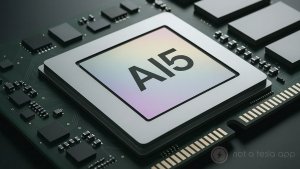
In a recent discussion on the All-In Podcast, Elon Musk provided some additional technical specifications of Tesla’s next-generation FSD chip, AI5. While we’ve already heard a lot about AI5, these new numbers are staggering, pointing to a huge leap in performance that dwarfs typical generational improvements between chipsets in the industry.
AI5 Specs
Elon described AI5 as having a 40x improvement in some metrics over the already powerful HW4 chip, framing AI5 as an absolute monster piece of hardware, which will eventually serve as the foundation for advancements in FSD and robotics.
AI5 isn’t just an incremental update; it’s an architectural step-change. Tesla has learned a lot since developing HW3 and HW4 and now has a better understanding of what it needs to solve FSD. AI5 will address the hardware bottlenecks Tesla is currently facing with HW4.
During the podcast, Musk revealed that AI5 will have 8x more raw compute power than HW4, and it’ll include 9 times more memory. Since hardware 4 includes 16GB of RAM, it appears Tesla is considering putting up to 144GB of memory in AI5. AI is extremely memory hungry, and we’ve heard for a while now that Tesla has been facing memory constraints on HW4, so it’s not surprising they’re increasing the amount of RAM drastically.
Musk also revealed that the memory bandwidth in AI5 will be improved by 5x over HW4.
NEWS: Elon Musk says Tesla’s AI5 chip will be up to 40X better than AI4 in some metrics, and 8x better in raw compute. 9x more memory.
— Sawyer Merritt (@SawyerMerritt) September 10, 2025
“I am confident that the AI4 chips currently in the cars will be achieve self-driving safety at least 2-3x that of a human, maybe 10x.”
via… pic.twitter.com/X3vUkzd4nc
Other Improvements
The specs are incredible gains on their own, but the true genius of the chip lies in its specialized design. That 40x improvement comes from how the chip handles specific, computationally intensive operations that are bottlenecks in the current system.
For example, a key mathematical function called “softmax” will run natively in fewer steps on AI5, and the chip will be able to dynamically handle mixed precision models much more efficiently. This type of specialized optimization is only possible when the teams designing the hardware and the software are working in complete lockstep.
A New Order of Magnitude
AI5 is expected to enable the next generation of FSD software. While Tesla has previously stated that they’ll be able to achieve Unsupervised FSD on hardware 4, we’re wondering if it’ll actually be achieved on AI5 first and then backported to HW4.
Once AI5 is released, Tesla will again not be limited by compute or memory, much like when they diverged from HW3. Once Tesla trained and built models exclusively for HW4, they were able to drastically increase model sizes and parameters, as they no longer needed to support HW3.
While Tesla still intends to achieve Unsupervised FSD on HW4 or offer a free upgrade, Elon has stated that AI5’s improvements will result in an order of magnitude increase in the quality and safety of FSD.
This powerful new chip is what will run future builds of FSD, including even larger models than the upcoming 10x parameter model intended for HW4.
Even with the current hardware, Elon remains confident that FSD will achieve a safety level that is two to three times better than that of a human, and with further optimization, potentially even ten times better.
Designing Purpose-built Chips
Elon emphasized that these massive, targeted gains are part of recent changes to Tesla’s approach to chip design and FSD. Now, Tesla is co-designing its hardware and software simultaneously, rather than buying off-the-shelf chips for training. This means that Tesla’s AI team can identify the exact mathematical operations and data pathways that are slowing down their neural networks, and work with the silicon team to design a chip that is purpose-built to eliminate those specific bottlenecks.
This first-principles approach to chip design is a core competitive advantage that allows Tesla to achieve performance gains that are simply not possible for competitors relying on third-party hardware.
The Bigger Picture: Optimus and AGI
While the immediate impact of AI5 will be on FSD, its significance extends to Tesla’s most ambitious future project: the Optimus humanoid robot. Elon is dedicating the majority of his time and effort to Optimus, which he believes will be the greatest product in the history of humanity.
Building a robot with a capable AI mind and human-like dexterity requires an immense amount of efficient, in-robot computing. The AI chip in Optimus could account for $5,000 to $6,000, or even more, of its eventual $20,000 to $25,000 production cost, and a powerful, efficient chip like AI5 could be the key.
The relentless push for more compute with less waste is all part of Elon’s broader roadmap for the future of artificial intelligence. In the same interview, he made his most aggressive prediction yet on the timeline for Artificial General Intelligence (AGI). He stated he believes AI could be smarter than any single human at anything as soon as next year, and by 2030, AI will likely be smarter than the sum of all humans.
You can watch the entire interview on the All-In Podcast below.