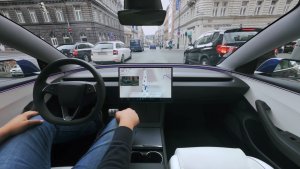
For anyone who has driven a Tesla with FSD, the on-screen visualization is a constant source of fascination. It’s a real-time glimpse into the neural networks that power FSD, showing the lanes, objects, and traffic controls it perceives.
A newly published patent application from Tesla, dated September 11, 2025, provides our best glimpse yet at where this visualization is headed. The patent, titled “Artificial Intelligence Modeling Techniques for Vision-Based High-Fidelity Occupancy Determination and Assisted Parking Applications,” details the complex AI model that will transform the current graphics into an even richer, high-fidelity 3D reconstruction of the world, all using Tesla Vision.
The image featured in the patent, above, provides a stunning preview of this future. A detailed, three-dimensional rendering of a parking scenario, complete with realistic surfaces, shadows, and painted ground markings, all recognized by the system. Taking that data and then rendering it into a user-facing UI using Unreal Engine is likely where we’ll see it in the future.
This isn’t just a cosmetic upgrade; it’s the visual output of a profoundly more capable perception system, one that will unlock powerful new features, starting with a complete reinvention of Tesla’s low-speed maneuvering in Autopark, Summon (Summon upgrade coming), and eventually, Banish.
The High-Fidelity Occupancy Network

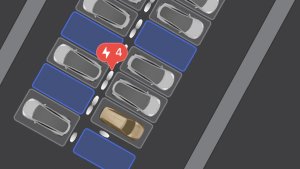
To understand the leap, one must first understand the technology at the core of the patent, the high-fidelity occupancy network. Currently, Tesla has two visualization systems. One that’s more representative of the real world, which creates models using data from the vehicle’s cameras, and another that recognizes objects and replaces them with predefined 3D models, as seen in FSD. The former visualization is observed during low-speed maneuvering on vehicles with AMD infotainment systems (image above).
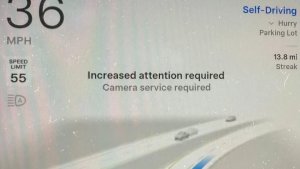
The FSD visualizations are cleaner due to the use of 3D models, but it can only display what it has models for, which doesn’t include walls, buildings, and many other objects. It provides generic shapes for cars, trucks, pedestrians, dogs, poles, and other objects (All FSD visualizations). It also presents lane and other traffic markings as the vehicle sees them.

An occupancy network, as seen in Tesla’s High Fidelity Park Assist, operates differently. It divides the entire 3D space around the vehicle into a grid of tiny cubes called voxels (volumetric pixels), and then uses an AI model to determine if each individual voxel is occupied by an object or if it is empty space.
The key innovation detailed in the patent is how Tesla determines that occupancy. Instead of a simple and binary yes or no, Tesla’s model predicts a “Signed Distance Field” or SDF. In the simplest terms, for any point in the 3D grid, the model calculates its precise distance to the nearest solid service. Points outside an object get a positive value, points inside get a negative value, and points on the surface get exactly zero - hence the signed portion of the distance field.
This technique allows Tesla to reconstruct the shape of objects with incredible detail and accuracy, moving far beyond generic vision models. The patent includes figures that contrast the high-quality rendering achieved with the SDF methods against the noisy, incomplete view from raw sensor data or the blocky view from a simple voxel grid. That’s an immense increase in quality, without a major hit on processing.
The best part is that this relies entirely on Tesla Vision. The entire 3D reconstruction, in all its minutiae, is achieved by relying only on the vehicle’s 2D camera feeds, and no reliance on LiDAR or radar.

A Revolution in Low-Speed Manuevers
While a hyper-realistic visualization is a groundbreaking feature in its own right, and definitely a head-turner for users, its primary purpose is to enable even more advanced autonomy capabilities. The most detailed application described in the patent is for a massive update to Tesla’s Autopark capabilities.
The process, powered by the new AI model, would work as follows:
First, FSD will determine that a car has entered a park-eligible area, based on its low speed, GPS location matching a known parking lot, or by visually identifying signs, stalls, or the orientation of other parked vehicles.
Then, using the high-fidelity 3D world reconstruction, the car identifies one or more available parking spots. The system can identify spots based on painted lines, even in open lots. It can also recognize the specific paint markings of handicapped spots. Just like today, the user can then select a recognized parking spot, or in the future, let FSD choose its own parking spot.
The true shift from today’s Autopark isn't just about selecting a spot; it's the foundational understanding of the entire 3D space that makes it possible. That means Autopark will be able to park faster, more confidently, and in tighter spaces, all without user intervention.
Of course, Autopark is only part of the formula here. Summon and Banish will also be key components for Tesla to apply this new patent’s techniques to. Each of these features will greatly benefit from the 3D reconstruction, enabling the vehicle to better situate itself and navigate complex urban spaces.
What This Means for Owners
The technologies outlined in this patent point to a future where the experience of using FSD is fundamentally more intuitive and confidence-inspiring, whether you’re in the vehicle or not. A visualization that accurately mirrors the real world, rendering the precise shape of objects around you, offers a level of assurance that abstract graphics simply cannot match. This builds trust for drivers and users by clearly communicating what the car sees and understands about its environment.
The patent is a detailed technical blueprint outlining how effective Tesla Vision can be at judging distances and understanding the 3D space around the vehicle, all without the need for additional sensors beyond cameras. It’s also a sign that Tesla is confident cameras can and will replace LiDAR and radar outside of specialized systems that require millimeter-level accuracy. Cameras, with the effective use of neural networks, are transforming a flat 2D image into a 3D representation of the world.
We can already see the very beginning of this with Tesla’s High-Fidelity Park Assist feature, but the future will become much more detailed, and one day this system will replace the FSD visualizations we see today.