How Tesla determines a road's speed limit is a common point of curiosity and confusion for Tesla owners. So how does a Tesla actually know the speed limit of the road it’s on?
The most obvious answer is that your vehicle reads the speed signs on the road as it passes, and while this is partially true, it isn’t the whole story. The reality is much more complex, and involves how your vehicle weighs mapping data versus signage it actually finds on the road.
Your vehicle is constantly cross-referencing what its cameras see in the real world with the known-good map data sourced from Tesla. Understanding how these two systems interact and work together is key to understanding how one of your vehicle’s most unassuming features operates.
The Power and Pitfalls of Vision
At its core, Tesla uses a series of powerful neural nets to power FSD and the entire Tesla Vision stack. One of these neural nets is trained for optical character recognition (OCR). This is what Tesla uses to read speed limit signs in real time, as you pass by. This vision-based system is essential to adapting to road conditions that static maps just can’t account for.
For example, your vehicle can use its cameras to identify and then obey temporary speed limits in construction zones - a clear instance where vision trumps maps. However, relying on vision alone has its limitations, and the system isn’t always perfect.
Many drivers have experienced poor visibility, causing FSD to miss signage, and sometimes, even on bright and clear days. Signs can be difficult to read sometimes, when obscured by the glare of the sun, overgrown tree branches, or blocked from view by other vehicles. If a speed sign is too far offset from the side of the road, your vehicle won’t read that either.
Beyond that, misinterpretation of speed signage can happen, and one of the most complained about misinterpretations is 60 and 80. Misinterpreting an 80 limit at 60 happens so often that it isn’t even surprising, but for the most part, signage is read accurately.
The Backup: Map Data
To create a more robust system that can deal with the pitfalls of imperfect signage and conditions, Tesla’s vision-based readings are constantly checked against a second source of truth: high-fidelity map data. This data includes key road attributes, including speed limits for specific segments of the road.
The primary strength of the map data is its reliability and persistence. It is not affected by the weather, a passing truck, or a damaged or misplaced sign. It provides a baseline ground truth for what the speed limit should be under normal conditions.
The main weakness, of course, is that maps become outdated relatively quickly. If a city lowers the speed limit on a particular stretch of road, it can take Tesla time to push out the next map update with the new speed limit. This can lead to situations where map data suggests a higher speed limit than the new signs on the road.
How They Work Together
The magic of Tesla’s system lies in how it fuses these two data sources. Your vehicle constantly performs a sanity check between what it sees and what it knows.
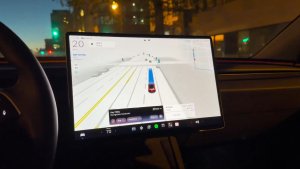
When the vision system’s confidence is low, for example, when it can’t get a clear read on a sign, or if there’s a direct conflict between two sources, your vehicle will often fall back to the known map data. This is generally the safer behavior, all things being equal.
However, if the vision system has high confidence that it has seen a sign, especially a temporary sign like in a construction zone, it will override the map data. This is the key to adapting to the real world. For instance, if your car suddenly tries to slow down on a highway for no apparent reason, it’s often because the map data for that GPS segment is incorrect (perhaps with an old, lower limit) and is temporarily overriding the car's vision system.
A Real-World Example
Pulling together a real-world example is the best way to illustrate how this works. There’s a local road where FSD often misinterprets a 40 km/h minimum speed zone as the speed limit. However, the speed limit there is 80km/h.
Rather than slowing down immediately, FSD will slow somewhat, based on traffic flow, continue to maintain the previous higher speed limit, and then, without any signage, switch back to 80km/h on the display.
Ultimately, determining the correct speed limit is a complex balancing act. It’ll take more time and more iterations for Tesla to perfect how this is done, but the way it works today is fairly effective, and aside from misinterpretations on low-traffic routes, it works quite well. You can read more about pre-mapped data and how it affects what your vehicle sees in our previous article here.