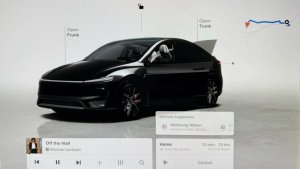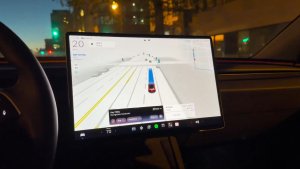
Drivers eagerly updating to the long-awaited FSD V14 have been met with a surprise. Upon installing the latest build of FSD, users may notice that Traffic-Aware Cruise Control (TACC) and Autosteer are completely unusable. While the options still appear in the UI, the features can not be activated.
In earlier version of FSD V14.1, Tesla displayed a message stating that “Traffic-Aware Cruise Control and Autosteer will be available in an upcoming software release,” however, this message has been removed in more recent builds and the features haven’t returned.
While this may seem like a bug or a feature that is temporarily disabled, it could also be a sign of a long-awaited architectural change for Autopilot.
Tesla may be beginning the process of unifying its Autopilot and FSD software suites into a single, more capable platform.
Correction: Tesla has reintroduced Autosteer in FSD V14.1.3 and up. However, in our experience, TACC remains unavailable, although it’s possible it’s simply a bug with our vehicle. However, the larger problem and question still remain. When will Tesla replace TACC and Auto-steer with a subset of FSD?
The Two Brains Problem
While on paper, FSD may seem like Autopilot with added capabilities to handle city streets, in actuality, it’s a completely different, much more advanced system, even when performing the same functions as Autopilot.
For years, Tesla vehicles have essentially run two separate driving brains at the same time. The legacy Autopilot (AP) stack has been responsible for core driver-assist and safety features like Lane Departure Avoidance, Blind Spot Collision Warning, Collision Avoidance Assist, Automatic Emergency Braking, Multi-Collision Braking, Obstacle-Aware Acceleration, Lane Assist, and Speed Assist.
That’s a massive host of features, primarily using unstitched data from single cameras around your Tesla, rather than the full camera array, which has been stitching the world together since FSD V12 to maintain situational awareness. For AI4 vehicles, that also means your safety net has been running at a lower resolution and refresh rate.
Simultaneously, the more advanced FSD stack has been running, using a full multi-camera view of the world to handle complex city street driving. Running both systems in parallel consumes additional computing resources, placing a ceiling on the potential size and complexity of the FSD model.
This is like having two different drivers in the car at all times—one focused on safety and another one focused on driving. However, in the vehicle the two systems are sharing and competing for the same computing power.
Moving Safety Features to the FSD Stack
FSD V14 appears to be the second step in retiring the old Autopilot stack for good. Tesla previously moved Lane Departure Avoidance and Lane Assist to the FSD stack, kicking off the process. By migrating all driving functions to the single FSD stack, Tesla is undergoing a massive engineering effort with two key benefits.
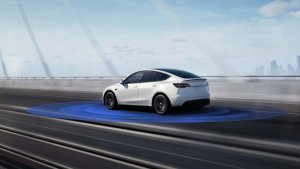
First, all standard safety features will now be powered by the FSD stack’s superior, multi-camera worldview, which can track vehicles that are occluded by other objects and predict their relative movements in the 3D space around your vehicle. This means features like emergency braking and lane keeping will operate with far more data and environmental context than before—a significant safety upgrade.
Second, eliminating the redundant AP stack frees up precious computing power, allowing Tesla to deploy even larger and more powerful FSD neural networks in the future. This could be what we’re seeing in FSD V14, Tesla is migrating systems over and allowing FSD V14 access to more computing power.
The Future of Autopilot
This unification has major implications. It suggests that the base Autopilot of the future will simply be a feature-limited version of the FSD stack, offering TACC and Autosteer powered by a far more advanced core software. Users will essentially be running FSD, but certain functions such as handling traffic lights or taking turns will be disabled. This provides a safer, more capable base system for all customers. However, it also raises important questions about how this new FSD-based system will be deployed and approved in regions where FSD itself is not yet legal, such as Europe.
For now, the temporary loss of TACC and Autosteer in FSD V14 is a short-term inconvenience that could be a sign of longer-term changes. It could be the foundational software rewrite that will not only make core safety features more powerful but also pave the way for a much more capable and redefined version of Autopilot.