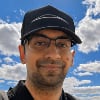
Ashok Elluswamy, Tesla’s VP of AI and leader at Macrohard, is leading one of the most ambitious artificial intelligence projects in history.
While Franz von Holzhausen crafted the beautiful hardware that captured the world’s imagination, Ashok is the one teaching that hardware to see, think, and reason. From the first iteration of Autopilot to the end-to-end neural networks introduced in FSD V12, his work is defining the future of autonomous vehicles and robotics.
A Foundation in Robotics
Ashok’s journey began not in Silicon Valley, but in India, where he earned his bachelor’s degree in Electronics and Communication Engineering from the College of Engineering, Guindy.
His passion for making machines interact with the real world led him to the United States and to one of the world’s premier robotics institutions: Carnegie Mellon University. There, he earned a Master’s degree from the Robotics Institute, immersing himself in the complex challenges of computer vision and machine learning.
His early career saw him tackling the building blocks of autonomy within the legacy auto industry. He worked at WABCO Vehicle Control Systems and later at Volkswagen’s Electronics Research Lab, developing computer vision systems and driver assistance features. He was already working on the problem of vehicle autonomy, but within the slow-moving, incremental world of traditional automakers, which included minor yearly updates.
Answering the Call
In 2014, Ashok made a pivotal decision. He left behind the established world of legacy auto to join a company that had just started to find its footing. He responded to a now-famous post on X from Elon Musk, who was looking to build a hardcore team to create the world’s first true autopilot system for consumer vehicles.
Engineers interested in working on autonomous driving, pls email autopilot@teslamotors.com. Team will report directly to me.
— Elon Musk (@elonmusk) September 18, 2013
Ashok was the very first engineer hired for Tesla’s Autopilot team and remains at the heart of the team today.
The task he found himself faced with was monumental. Unlike his previous roles, this wasn’t about simply developing a single, isolated feature that would go out for the next model year. Instead, he was building a world-class software team tasked with developing an autonomous driving system from near zero, under a CEO with an extraordinarily ambitious vision for full self-driving.
Teaching the Fleet to See
The first fruit of that herculean labor was the original Autopilot, which stunned the world by bringing features like Autosteer and Traffic-Aware Cruise Control to a production vehicle. But this was just the beginning. The team’s greatest challenge and biggest breakthrough was the transition to Tesla Vision.
In a highly controversial move, Ashok’s team led the charge to remove radar from Tesla’s sensor suite, arguing that a system relying on two different sensor inputs (vision and radar) was fundamentally flawed.
The only way to solve for general autonomy, they believed, was to solve for vision first, just as humans do. This first-principles approach was met with great skepticism, but it proved to be a critical step, forcing the team to build a more robust, camera-based system that could scale across millions of vehicles and countless environments and locales around the world. In the end, vision was the correct move as it’s immensely more trainable than something like LiDAR. You can easily train vision by feeding it millions of hours of humans driving, while the same isn’t the case for LiDAR or radar.
The End-to-End Revolution
Ashok’s tenure has culminated in perhaps the most significant architectural leap in FSD’s history: FSD V12. As a key presenter at Tesla’s AI Day events, he explained this shift to the world. Instead of hundreds of thousands of lines of C++ code telling the car how to handle specific situations, V12 is an “end-to-end” neural network.
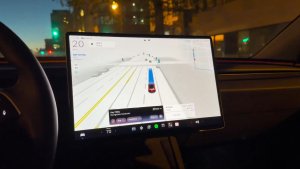
It takes in video from the car’s cameras and outputs driving controls directly, learning how to drive by watching millions of hours of real-world video data.
This is the software equivalent of Franz’s Cybertruck - a complete break from convention, replacing a complex system of rules with a single, powerful, learning-based AI. It is the foundational technology that pins all of Tesla’s ambitions in relation to AI and autonomy, especially Robotaxi and Optimus.
Ashok Elluswamy's portfolio at Tesla isn't just a series of software updates; it's the steady, methodical, and brilliant execution of a plan to solve one of the hardest challenges on the planet. He is the quiet architect building the mind of the machine.