In a recent post on X, Elon Musk has laid out a beautifully simple vision for what he imagines your Tesla will be able to do in the near future.
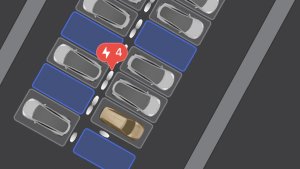
You’ll be able to set a destination, choose store entrance drop-off in FSD, and then get out of your car. Once you do, it will simply depart and go find itself a nearby parking spot. Then, when you’re done with your shopping, you just tap Summon on your phone, and your car will be waiting for you at the entrance, right where you stepped out.
In the near future, your Tesla will drop you off at the store entrance and then go find a parking spot.
— Elon Musk (@elonmusk) October 10, 2025
When you’re ready to exit the store, just tap Summon on your phone and the car will come to you. https://t.co/7oUEk9Bb0H
This seamless and magical experience, combining Banish (Park Seek) with a more robust Smart Summon, has long been a goal for Tesla. In fact, it was first mentioned back in 2022 and more recently mentioned in 2024 as part of V12.4, but as we all know, that never happened.
The other day, Ashok Elluswamy suggested that Banish would be included in V14.1.2, but it turned out to be Mad Max mode instead.
But better Summon and Banish aren’t exactly features that can be turned on overnight. They’re a direct result of major advancements to FSD, and we’re finally seeing the puzzle pieces begin to fall together with FSD V14 and its destination parking options. Let’s take a look at why it has taken so long for all to come together.
The Brain: V14
At the core of all of this is FSD V14 and its massive architectural leap. A chaotic, GPS-denied parking lot, with its unpredictable pedestrians, erratic drivers, and poorly marked lines, is one of the most challenging and complex environments for an AI to navigate.
The new 10x parameter neural network in V14 provides the raw intelligence needed to handle the thousands of various normal and edge cases you’d encounter in a parking lot, moving beyond just simple lane-selection and cruising to true, complex, low-speed maneuvering.
Mastering the first and last 5% of each drive is what makes FSD v14 truly special.
— Zack (@BLKMDL3) October 13, 2025
The way it pulls into parking garages and parks + unparks makes it where now, 100% of your drive is on FSD. pic.twitter.com/y9weJfsWY5
The Eyes: The Front Bumper Camera
For years, FSD has had a critical blind spot: the area directly in front of the bumper. The main windshield cameras are mounted far too high to accurately see low-lying concrete curbs, parking blocks, or sometimes, even poorly painted lines.
The recent addition of the front bumper camera on new Tesla models is the hardware solution to this problem. We’ve previously argued that the bumper camera will be a necessity for Unsupervised Smart Summon and Banish, and we expect that to remain true.
The bumper camera provides the crucial, low-down perspective needed for the final inches of a parking maneuver, or to carefully avoid obstacles close to the vehicle. That gives FSD the confidence to pull all the way into a spot or to go around an obstacle without any fear. As recently discovered in V14.1, FSD now actively uses this camera and will request it to be cleaned if obstructed, confirming its essential and active role.
The Understanding: New Visualization Assets
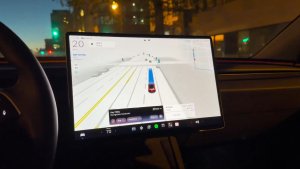
The final piece of the puzzle is perception. An AI can’t safely navigate a parking lot if it can’t distinguish between a shopping cart, a stroller, and a person in a wheelchair. The latest discovery of a massive library of new, highly specific 3D visualization assets in the latest software update is the clearest evidence that FSD is learning to see the world in much greater detail.
When the car can accurately determine and render a stroller, a skateboard, or a wheelchair, it’s a sign that the underlying AI can classify these vulnerable road users with a high degree of precision. This deeper understanding is necessary for the proactive and cautious navigation required to autonomously seek a parking spot in a busy retail environment.
Elon’s vision of a truly automated parking experience isn’t just a far-off dream; it’s the culmination of a deliberate, multi-faceted engineering effort to solve the last 100 feet of every journey.