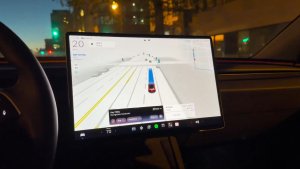
Following a tease from Tesla’s VP of AI, Ashok Elluswamy, earlier in the day, Tesla has begun rolling out another rapid point release to its early access testers. This new version of FSD, V14.1.2, is arriving with software update 2025.32.8.10 to Tesla’s small cadre of external testers.
This new point release comes just days after FSD V14.1.1, and reintroduces a long-time fan favorite feature from past FSD versions: the more aggressive Mad Max driving profile.
The Return of Mad Max
For long-time FSD users, Mad Max Mode is a familiar name. In previous versions of FSD, it was known as the most assertive lane change profile, willing to make frequent and decisive lane changes to navigate through traffic as fast as possible. With its reintroduction in V14.1.2, it seizes the reins from the relatively new Hurry Mode for the fastest and most aggressive FSD profile.
Keep in mind that as of FSD V14, FSD Profiles now also incorporate speed, instead of relying on a separate Max Speed setting. As per the official release notes, the new Mad Max Mode provides a more assertive driving style than the Hurry setting, offering higher speeds where appropriate and more frequent lane changes to get around slower-moving vehicles.
This video below, shows the new Mad Max mode in action:
FSD v14.1.2 Mad Max mode is amazing and I love it.
— Zack (@BLKMDL3) October 16, 2025
Perfect for LA traffic 🤣 pic.twitter.com/FtHTF1SC1b
A New Five-Level System
With the addition of Mad Max Mode, Tesla has now fully defined its new, five-level hierarchy for FSD driving profiles. This system replaces the old three-tier “Chill, Standard, Hurry” system, and more recently, the manual speed controls and offsets, which were removed with the launch of FSD V14.
The new profiles allow drivers to select a driving “personality,” ranging from extremely cautious to highly assertive:
Mad Max: The most aggressive setting for speed and lane changes.
Hurry: A confident and assertive driving style.
Standard: The default, balanced profile.
Chill: A more relaxed, passive driving style.
Sloth: The most cautious setting, which strictly adheres to speed limits.
As Speed Profiles now impact how aggressively the vehicle will maintain or exceed the speed limit, the new Mad Max Mode will be useful for those who really just want to get going through traffic and exceed the speed limit. Sloth will travel slower than Chill or Standard, and Standard will have a slower overall speed than Hurry, while Mad Max pulls all the stops.
Other Expected Improvements
Since this is a point release, Tesla has likely rolled in other improvements to stability, decision-making, brake-stabbing, and smoothness that have been mentioned lately by testers. While FSD V14.1.1 did make some beneficial changes to address tester feedback, V14.1.2 likely makes further changes to help improve the experience.
The Release Cycle
This feature release on the newest build is only going out to Tesla’s early-access testers, and this follows their well-established FSD rollout process. Over the next few days, these testers will put FSD V14.1.2 and Mad Max Mode through its paces and report back.
If the feedback is positive, this version could potentially become a candidate for a wider public rollout, but if not, we can expect to see another point release before Tesla takes the step to move straight to V14.2.
This update still does not provide FSD v14 support to the Cybertruck, which is on a separate development path thanks to its all-wheel steering, and is expected to receive its own feature-complete version of V14 later this month.
Furthermore, as v14.1.1 is built on the 2025.32 software branch, the early access testers still won’t have access to the new features from 2025.38, including 3D maps and Tron Mode.