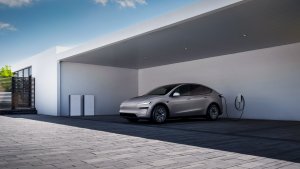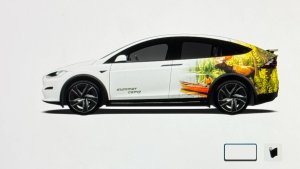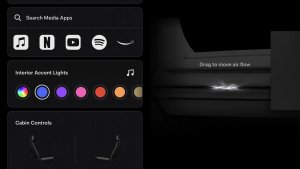
Tesla has rolled out a new software update in China that enables vehicle-to-load (V2L) capability for the new Model Y L, allowing owners to power external devices directly from their vehicle. The update expands the functionality of the currently Chinese-exclusive Model Y L.
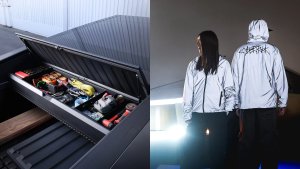
The only other Teslas capable of V2L functionality are the Model Y Performance variant and the Cybertruck. However, the Cybertruck is in a league of its own, capable of extracting enough energy to power an entire home.
What the Update Adds
While the Model Y Performance became the first model to support V2L after the Cybertruck, this addition to the Model Y L came as a surprise in software update 2025.32.
The update allows users to connect and operate household devices like coffee makers, laptops, or even small kitchen appliances — making it useful for camping, outdoor activities, and emergency backup power situations. You can even charge another Tesla with it, but the max power is limited to 20 amps at 120V, or 2.4kW. For comparison purposes, a mobile or Wall Connector can charge a Model 3 at about 30 miles per hour using 32 amps at 240 volts, or 7.6 kW. Charging another Model 3 via V2L would charge it at about 10 miles per hour — not exactly fast, but enough for some situations.
Available Models and Regions
Besides the Cybertruck, Tesla has only started adding V2L capabilities to newer vehicles, which include the Model Y Performance and Model Y L. However, this does not include the 2026 Model Y. These capabilities will likely remain in place as these models are introduced in other regions. However, it’s not clear whether Tesla will ever add V2L capabilities to existing vehicles.
Thanks to third-party efforts, we know it’s possible to extract energy from existing Tesla models. Still, Tesla has chosen not to make this feature available on other models, potentially due to concerns about battery degradation.
The Model Y Performance includes newer Panasonic batteries that are likely capable of more charge cycles over their lifetimes, which gives Tesla the confidence to enable the feature while still meeting its warranty goals.
While Tesla has numerous models scheduled for release in the future, none are consumer-focused, and none are likely to feature V2L capabilities. However, if the feature relies on the new Panasonic batteries, newer versions of existing models could add the feature if Tesla can source enough batteries from Panasonic.