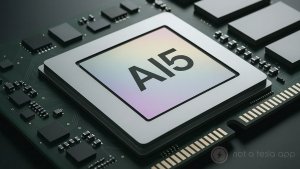
Tesla’s next inference chip is no longer a slide-deck promise. Elon Musk confirmed that AI5 will arrive in late 2026 with a “small number of units,” with high-volume production slated for 2027.
The chips will be built in parallel by both TSMC and Samsung.
Both fabrication plants will manufacture the same chip design, but the physical implementation of that design will differ because each fab uses its own transistor libraries, routing rules, and manufacturing optimizations. This isn’t unusual—Apple’s A9 chip, for example, was produced by both Samsung and TSMC. Although the two versions were physically different and had small differences in power and efficiency, Apple kept their real-world performance nearly identical by adjusting clock speeds and power settings.
Musk added that while the chips may be physically different, the goal will be to have them run identical AI software.
Why Two Fabs?
Tesla is likely splitting production for three main reasons. First, risk. A single fab fire or exporting regulation cannot stall Tesla’s entire global vehicle production, much less the initial rollout of the Cybercab, which will be the first vehicle to receive AI5 hardware.
Tesla is also relying on AI5 at its data centers. Since Tesla shut down Dojo, the plan is for AI5 to take its place at its data centers.
By splitting production, Tesla also has TSMC and Samsung competing against one another for price, potentially reducing the cost of the chip.
The last reason for Tesla to split the fabrication of AI 5 is likely speed. Having two fabs producing AI5 means that you have two production lines running at speed, which is exactly what Tesla needs. With AI5 needed in the data center, in Cybercab, in Optimus, and in the initial tranche of consumer vehicles, there’s going to be significant demand — millions of chips per year.
Slightly different versions of the Tesla AI5 chip will be made at TSMC and Samsung simply because they translate designs to physical form differently, but the goal is that our AI software works identically.
— Elon Musk (@elonmusk) November 4, 2025
We will have samples and maybe a small number of units in 2026, but high…
AI5 Performance
Tesla recently discussed the performance of its future AI5 hardware, which will offer up to a 40x improvement in compute over HW4. However, this is likely in very specific situations.
Tesla, like many others, has realized that modern AI models are extremely memory-hungry, especially for real-time vision tasks. One key to enabling unsupervised FSD is increasing the model’s context length — the amount of past video and driving data the network can analyze at once. A longer context length allows the vehicle to better understand how the scene is changing over time, anticipate behavior, and make smoother decisions.
To address this, Musk has said that AI5 will have 9x the memory of the current HW4 units, letting Tesla cram much larger models into the vehicle.
You can read more about AI5’s performance and how it compares to HW4.
Release
While AI5 will be a huge step up from HW4, the timeline isn’t as close as we hoped. We’re now looking at a year, and likely more, before AI5 hits the streets. That’s a little less ambitious than we previously heard, but this one is more solidly grounded in reality. Back in Q2 2024, Elon predicted 18 months to the first customer deployments of AI5, but now, here in Q4 2025, we’re looking at another 12-18 months.
Chips are hard, and fabs are expensive and take a long time to build, so this isn’t surprising, even with Elon walking Samsung’s production lines in Texas.