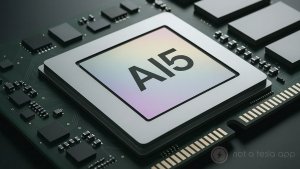
You can often tell what Musk and Tesla are working on based on Musk’s posts on X. Musk has been sharing additional details on Tesla’s upcoming AI5 FSD hardware chips over the past couple of months, and just the other day, he laid out the roadmap for Tesla’s FSD hardware for the next several years.
AI5 - Hardware 5
Tesla’s next FSD computer is going to be a big jump from the current hardware 4 in today’s vehicles. While hardware 4 is much more powerful than hardware 3, it never really lived up to its potential, potentially due to manufacturing constraints during COVID.
However, we’re now clear past the Covid-era shortages, and Tesla has learned a lot about what it takes to power its AI models. While compute power is important, memory is key, and the current hardware struggles and needs to be optimized to run the current AI models.
Musk already said that Tesla will provide two slightly different versions of AI5 because they’ll be made by different manufacturers — TSMC and Samsung.
The timeline for AI5 production is aimed for late 2026, with Musk saying that a “small number of units” will be available in 2026, but high-volume production will only be possible in 2027. This puts us roughly a year out from AI5 hitting production vehicles. Musk previously shared compute comparisons between hardware 4 and AI5, and this is going to be a huge upgrade.
What About the Cybercab?
What’s interesting here is that while Tesla only plans to introduce AI5 at the very end of 2026, Tesla still plans to release the Cybercab before AI5 chips are available. Our take here is that Tesla will either introduce use the “small number of units” made in 2026 for the Cybercab, or that it will build the Cybercab with plans to run AI5. That means that it’ll build the Cybercab with the AI5 power and space requirements, but then stuff HW4 in there for now — leaving an upgrade path for AI5.
While HW4 is doing an amazing job running the current FSD models, Tesla engineers are battling constraints, and autonomy is still far from done. Instead of manufacturing Cybercabs that could potentially become paperweights since the vehicle won’t have a steering wheel, they’ll likely plan an upgrade path for this newly designed vehicle.
AI6 - Hardware 6
Musk’s posts went beyond AI5. He also discussed AI6 and even AI7. Musk stated that AI6 will use the same fabs as AI5, but Tesla sees a clear path to doubling AI5's performance with AI6. He expects this to happen within 10-12 months of AI5 shipping.
While Tesla kept FSD HW3 around way too long before introducing HW4, they’re not making the same mistake with AI5. With AI6 being based on AI5, Musk said that it’ll hopefully enter volume production in 2028, just a year after AI5 becomes widely available.
AI7 - Hardware 7
While Musk also mentioned AI7, he didn’t go into as much detail as he did about the other upcoming hardware. He simply said that AI7 would need different fabrication plants because it’s more “adventurous.” Tesla will likely continue to revise what AI7 looks like as it discovers other ways to improve on AI5 and AI6.
What’s important here is that Tesla is already thinking about and planning for AI7, which means it could have an upgrade path from previous hardware and could also be a quick follow-up to AI6.
More Than Just Compute?
Tesla is heavily focused on compute with the new FSD hardware, but changes are necessarily limited to the FSD computer. Hardware 4 introduced improved cameras with higher resolution and better performance. Tesla also introduced the front-bumper camera in later stages of HW4, so making other changes in AI5 or AI6 aren’t out of the question. However, if we see other changes, the most likely are around the cameras, which would improve low-light situations, reduce glare, or further mitigate flicker.
Today, there’s a big difference between HW3 and HW4, with only the latter FSD computer being able to run the latest FSD models. However, with Tesla shifting toward more of an annual release cadence, the differences between hardware revisions could be much smaller, meaning older hardware won’t be left entirely out of running the latest FSD software for years to come.