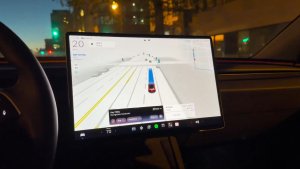
Tesla has launched a dedicated, live-updating safety dashboard to showcase the real-world performance of FSD (Supervised). The new hub, located at tesla.com/fsd/safety, moves beyond the company’s traditional quarterly Vehicle Safety Reports and offers a more transparent, real-time view of the system’s real-world impact and safety record.
Tesla also posted a video to accompany this new Safety Hub, demonstrating the kinds of incidents and accidents that FSD (Supervised) has already prevented.
With FSD Supervised engaged, you're 7x less likely to be involved in an accidenthttps://t.co/AaKZlWvuTR pic.twitter.com/C7fBV3eaZ6
— Tesla (@Tesla) November 14, 2025
Transparent, Live Feedback
The standout feature of the new page on Tesla’s site is a live mileage counter, which ticks upward in real-time to display the total miles driven on FSD (Supervised). This feature helps to demonstrate the massive scale of Tesla’s data engine visually. It breaks down the miles into Total and City driving for FSD, emphasizing that FSD isn’t just for highways, but also for city driving.
FSD Miles Driven Per Day

The code on Tesla’s site reveals exactly how much FSD miles driven are increasing by. The website starts with a base number of how many miles have been driven on FSD. It then increases those numbers based on a linear formula based on the date and time. That formula essentially reveals how many miles Tesla is seeing driven on FSD every second.
Total Miles: For total miles driven on FSD, the website adds 166.6 miles per second, or 14.4 million per day.
City Miles: City miles are a subset of total miles, so they’re being calculated at 65 miles per second or 5.616 miles per day.
Since we have total miles and city miles, we can also calculate the number of highway miles driven with FSD: 101.6 miles per second, or 8.784 million miles per day. Less than twice the miles driven on city roads.
Tesla announced that it hit 6 billion miles driven on FSD at their 2025 shareholders meeting in October. Based on the number of miles Tesla is seeing today driven on FSD, that means they should reach about 7.3 billion miles driven on FSD before the end of the year.
While the rate of FSD use will likely increase, if Tesla maintains a similar rate of use, it’ll hit 11.2 billion miles by the end of 2026.
7x Safer Than Humans
The dashboard presents a stark, data-driven comparison between human drivers and FSD. According to Tesla’s data, driving with FSD (Supervised) results in:
7x fewer major collisions (airbag deployment)
7x fewer minor collisions
5x fewer off-highway collisions
Tesla defines a collision as any event with significant impact (airbag deployment, pyro fuse activation, or other sufficient force), and critically, their methodology for reporting includes any incident where FSD was active within 5 seconds of the crash.
This means that Tesla doesn’t simply include incidents with FSD enabled at the time of impact - it includes incidents where FSD was enabled up to and including the critical event. This is a positive sign of ownership of real data from Tesla, especially with ongoing investigations into the safety of FSD.
Solving for Human Error
One of the biggest positives of FSD is that it helps to solve for real-world human error. People make mistakes by getting distracted, overconfident, or otherwise influenced - but a computer is always paying attention.
Tesla cites on their new safety page that NHTSA data shows that 90% of current road fatalities in the United States are caused by human flaws like drunk driving, speeding, and distraction. By eliminating the human variable from the complexities of driving, Tesla argues that FSD could potentially save over 32,000 lives and 1.9 million injuries in the US alone.

FSD has the potential to make a tremendous positive impact, not just for those who can’t otherwise easily access transportation, but also to help keep people safe. Seeing Tesla tackle the data that regulators are looking for openly and transparently is a great win for everyone.
Next, we’ll have to see if that data is convincing enough for regulators to allow for text-and-drive or Unsupervised FSD.