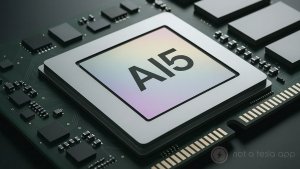
Elon Musk has confirmed on X that volume production of Tesla’s next-generation AI5 chip will not be ready until mid-2027.
The key takeaway is that the Cybercab, initially slated to launch alongside AI5, will instead launch on the current-generation AI4 hardware. Elon shared the update after wrapping up a design review for the new chip, which he attended alongside Dell CEO Michael Dell.
Yup. Just wrapped up the AI5 Saturday chip design review a few hours ago. We’re starting to do some work on AI6 too.@MichaelDell and I happened to be meeting just beforehand, so I invited him to join. Hopefully, he found it interesting.
— Elon Musk (@elonmusk) November 15, 2025
Btw, AI5 will not be available in…
The Cybercab Gap
In his post, Elon explained the logistical bottleneck. Essentially, Tesla requires thousands of boards for FSD training in its labs and supercomputing clusters. With both Samsung and TSMC tapped to begin production of AI5 as soon as possible, even Tesla’s hard push for silicon won’t be bringing AI5 to vehicles any faster.
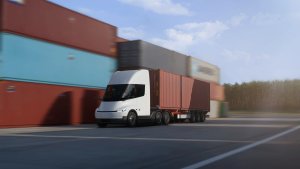
This creates a gap in the timeline. Tesla has officially targeted April 2026 for production of the Cybercab. With AI5 volume availability lagging behind by a full year, the dedicated robotaxi is expected to be rolling off the line equipped with the most current hardware - AI4.
AI5, which Elon has claimed is 40x more capable for certain inference tasks, is not strictly required for unsupervised autonomy. Instead, it serves primarily as a future efficiency and performance upgrade for vehicles and Optimus.
This also puts the burden of solving Unsupervised FSD firmly on the hardware currently shipping in millions of customer vehicles.
A Big Deal for Optimus
While the delay is notable for the car side of the business, Elon also shared some critical breakthroughs that are a game-changer for Optimus, Tesla’s humanoid robot.
Looks like we can bring power consumption down closer to 250 Watts, which is a big deal for Optimus.
— Elon Musk (@elonmusk) November 15, 2025
Important to note that AI5 is a specialized inference chip for the Tesla AI software. That said, it will perform – for our purposes – much better than anything else available.…
Tesla has worked to specialize AI5 for FSD’s neural networks, and as a result, the chip's total power draw has dropped closer to 250 watts. That’s a big step forward for Optimus.
For a Model Y with a ~75kWh battery, a computer drawing 500W versus 250W is a negligible difference in range, since the vehicle is using so much energy for driving. But for a humanoid robot with a battery likely in the 2-3kWh range, a power-hungry chip is a dealbreaker.
If the AI computer were to draw 500W+ (typical for something like NVIDIA’s Blackwell), it would drain Optimus’ entire battery in just a few hours, leaving little energy for the motors and other components of the robot. By cutting power draw to ~250W, Tesla is effectively increasing Optimus’ total uptime.
A Big Deal for HW3
For those waiting for a retrofit, while the news of delays may not be the best, the news of the reduced power draw is big. One of the challenges Tesla faces in building a retrofitted AI computer for HW3 vehicles is total power draw and total heat capacity.
By building a more efficient chip, both those values are reduced, and the closer they can get them to the original HW3 values, the better. That means Tesla may not have to retrofit vehicles with new forward wiring harnesses or remove the glovebox for additional cooling hardware. While HW3 still uses much less power at about 80 watts, it makes a more efficient, “lite” version of AI5 a possibility for a retrofit.
When to Buy a New Tesla
As many always say, the best time is yesterday, and the second-best time is today. Because of the delays in the AI5 chip, unless you intend to wait until mid-2027 to get your hands on the first consumer vehicles with AI5, you may be better off just buying an AI4 vehicle today.
At the end of the day, AI5 is a specialized inference chip. It has been stripped of legacy components, such as traditional GPU cores and image signal processors, that aren’t needed for Tesla’s neural networks.
That specialization requires more time to get production rolling, but makes it far more capable and efficient. If you’re hunting for a new Tesla, now may be a better time to buy instead of waiting two years.