Tesla has released the next major update of FSD, version 14.2. This update went out to early-access customers this morning and includes several major features and improvements.
FSD v14.2 is supposed to be one of the major FSD releases in 2025. While the release notes for this release remain mostly the same, it includes one significant new addition — a neural network vision upgrade.
Neural Network Vision Upgrade
The upgraded neural network vision encoder now uses higher-resolution imagery from the cameras, which should improve FSD performance, especially in areas that can benefit from higher detail. Tesla specifically mentions a few use cases, including handling of emergency vehicles and obstacles on the road.
However, they also mention one of the biggest additions, the ability to handle human gestures. The first gestures a vehicle will likely understand will be stop and someone waving the vehicle on.
The release notes state:
- Upgraded the neural network vision encoder, leveraging higher resolution features to further improve scenarios like handling emergency vehicles, obstacles on the road, and human gestures.
While the release notes make this seem like an incremental update, one of Tesla’s engineers has already commented, saying that “this is not a small update.” While the capabilities have stayed mostly the same, Tesla may have increased the number of parameters, the amount of training, or other changes that haven’t been shared yet.
The next major release of FSD is v14.3, which Musk has famously stated that the vehicle will begin to feel sentient. According to statements made in October, v14.3 is expected several weeks after v14.2, which still slates it for this calendar year.
New FSD Stats Menu
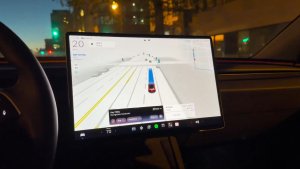
There’s a big surprise in FSD v14.2 that a lot of users have been hoping for, and it isn’t mentioned in the release notes. Under the Autopilot menu, there’s a new feature called Self-Driving Stats. This new section tracks the vehicle's total miles driven and the number driven with FSD enabled.
At the top, it shows the percentage of miles driven with FSD since FSD v14.2, meaning that the statistics aren’t retroactive.
This could theoretically have been added to the Trips menu, since it’s really another trip meter. The advantage of adding it to Trips would be that it could be shown in the Trips widget that shows up when you swipe left on the music player in a Model 3, Model Y, or Cybertruck.
The FSD statistics shown are per vehicle and are not tracked for each individual driver, so if multiple people use the same vehicle, the stats will reflect everyone’s usage.
Unlike other trip meters, Tesla doesn’t allow you to reset this meter. It’s not clear whether Tesla reset this meter at all or with each major FSD release. However, it’s likely to be reset at some point as FSD continues to improve and usage increases.
Tesla, if you’re listening, we’d love to see even more stats. Maybe the number of disengagements per 1,000 miles, or the number of hours that have been saved by letting the vehicle drive.
UI Updates / FSD Settings
With all versions of FSD v14.1, including FSD v14.1.7, you had to start FSD before you could change speed profile and arrival options. However, that’s now changing with FSD v14.2, which allows you to change settings before starting FSD.
This is especially useful when you’re parked. Just like you’d enter your destination before starting to drive, you can now set your preferred speed profile and parking options before you drive.
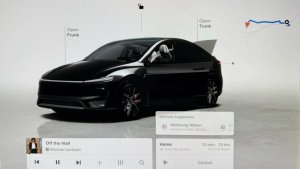
Underneath the always-present Start Self-Driving button, it now shows the selected parking option for that destination, even if FSD isn’t active. Tapping this new text will show the familiar speed profile settings and arrival options.
While the speed profile can be easily changed while driving by scrolling the right scroll wheel, the destination parking options require interacting with the touchscreen.
Once you’ve selected you’re options, you can tap outside of the module or the X close button to get back to the Start FSD button. It’s a bit of a back-and-forth, and Tesla could make this even better by keeping the Start Self-Driving button on the screen as you adjust the arrival options, so you can start FSD with a single tap.
FSD V14.2 New Feature
— Devin Olsen (@DevinOlsenn) November 21, 2025
You can set your driving profile and destination parking options before you start the drive.
Also I’m an idiot and TWICE pressed the open frunk button while trying to film this clip. Perhaps @Tesla_AI could make it so if you “tap out” of the parking… pic.twitter.com/rK4IXFXvu4
Release
Just like we saw with FSD v14.1, this release is only going out to early-access testers right now. While we may see a faster rollout than FSD v14.1 due to it being a smaller release, it’ll still be a staged release. We’ll hopefully see additional waves in the coming days.