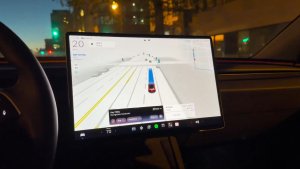
For years, the critique of Tesla’s FSD approach was that it lacks common sense. It excels in the mechanics of driving, including lane keeping, braking, and turning. While it has improved significantly, especially in FSD v13 and v14, it can still struggle with the high-level reasoning required for complex scenarios.
A car might stop for a construction worker holding a “Slow” sign, but would it understand that the worker is looking away and chatting, while waving traffic through? Would it understand that the lane that’s moving faster on a road to the right is not the right one to be in for the moment, due to the upcoming lane closures?
These are real scenarios FSD struggles with today, and Tesla is now actively hiring an AI engineer to solve this exact problem. This new job posting, for an “AI Engineer, Reinforcement Learning and Distillation,” is a role explicitly tasked with developing smarter, more contained models.
Instinct vs Reason
To understand why this matters, we can examine the way Andrej Karpathy, Tesla’s former Director of AI, discussed System 1 (fast and intuitive) versus System 2 (slow and reasoning) thinking (video below). This framework defines how human thinking works, and in short, we need to apply that same framework to how an AI model works.
System 1 thinking is fast, instinctive, and emotional. It is what you use when you drive a familiar route to work. System 2, meanwhile, is slower, deliberative, and logical. It's the type you use when navigating through a construction zone or series of highway interchanges.
Current end-to-end FSD is effectively a perfectly accurate System 1. It maps pixels to controls with incredible reaction time, but it lacks a dedicated System 2. A parallel reasoning layer that can think through a problem before acting.
In fact, Tesla’s job posting admits this: "These models continue to struggle in real-world physical reasoning, often struggling to tell left from right."
Distillation
The second half of the job title, Distillation, is the key to how this System 2 thinking will actually reach your driveway. Reasoning models are massive. They require immense amounts of compute and thinking time that a moving car simply doesn’t have. You can’t wait 10 seconds for your car to ponder whether to go or stop.
That’s where the act of distillation comes in. Tesla plans to train these massive System 2 reasoning models in their own data centers, which will act as “teachers,” generating perfectly reasoned solutions of millions of complex driving edge cases.
Those solutions can then be trained down for smaller, faster “student” models that can run side-by-side with FSD on your car’s local inference chip. The result: a car that has the instincts of a reasoning genius but maintains its perfect pixel-to-control reaction time.
Distillation isn't just optimization; for HW3 owners, it is the only bridge to the v14 era.
What About HW3?
When you look at it broadly, distillation is exactly the means that Tesla used to build FSD V12.6.4, which is a distilled, simplified version of FSD v13.2.9. Once reasoning is solved, these engineers will likely move on towards distilling the simplified version of FSD v14-lite that was previously mentioned at the recent Q3 2025 Earnings Call.
Reasoning is Key
This hiring push hints at Tesla moving beyond simply throwing more and more data at FSD in the act of training it better. Now, they are looking at changing the way the car thinks ahead, moving from pure imitation to a genuine physical understanding of the world around it.
For the edge cases that currently cause FSD to hesitate or throw up red hands, this reasoning layer is likely the final bridge from Supervised to Unsupervised.
There’s a lot to look forward to - and the reasoning space is one that Tesla hasn’t really stepped a foot into quite yet, but it is one of the spaces where we’ll see some of the greatest and most visible progress, versus the more granular, iterative steps between v13 and v14.