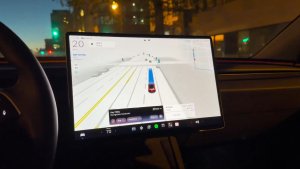
Tesla has officially begun its highly anticipated FSD ride-alongs in parts of Europe, giving the public their first real-world experience with the technology on local roads.
While the underlying neural nets are still FSD v14, early observations from participants in Germany, France, and Italy reveal that Tesla has tailored the experience to appease strict European regulators, making it a little different from its North American counterpart.
Same Stuffing, Different Packaging
Participants are being driven by Tesla employees in Model 3 and Model Y vehicles running FSD v14.1.7. While this isn’t the latest build (v14.2.1 in North America), it is a recent v14 build.
This version includes several distinct UI changes and behavioral constraints that highlight the tightrope Tesla is walking as it works to get FSD approved by bodies like the UNECE. The car may "think" the same way as its American cousins, but it acts with European politeness.
“Hands-Ready Mode”
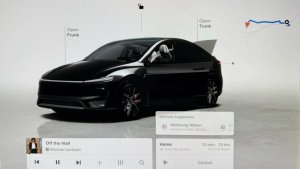
The most immediate visual change on the display is how FSD defines the driver’s role. In North America, when engaging FSD, the UI displays “FSD (Supervised) hands-off mode on “ if the vehicle is using the cabin camera to detect inattention.
However, in Europe, when engaging FSD, the display reads: “FSD (Supervised) hands-ready mode on.”
That’s some fairly different language, and almost certainly a compliance measure for the upcoming UNECE DCAS (Driver Control Assistance Systems) regulations. European regulators are defining a specific category for systems that allow hands off the wheel only if the driver is monitored and immediately available to take over.
By calling it “hands-ready”, Tesla is aligning the interface to the letter of the law — continuous torque on the wheel is required, but instant readiness is required.
Speed Limit Controls Return
Most FSD users are accustomed to selectable speed profiles, ranging from Sloth, Chill, Standard, Hurry, and Mad Max. These allow your vehicle to select speeds and aggressiveness and lane changes based on the profile — essentially letting FSD decide how fast to drive.
In Europe, the speed profiles are notably absent on the UI, instead leaving space for a user-selectable max-speed setting, just like FSD v13. A user in Italy noted that the Tesla employee set the max speed to +10km/h, which would allow the vehicle to do 70km/h in a 60km/h zone — similar to the old relative max speed option in older FSD builds.
Informing Before Acting
Another returning UI feature, this time from FSD V11, is an explicit broadcast of intent on the screen. A few seconds before FSD begins a significant maneuver, text appears on the screen informing the occupants of the car’s plan - for example: “Initiating left turn maneuver.”

This addresses additional UNECE regulatory requirements on DCAS systems, informing drivers before it initiates its own maneuvers. This also helps to inform new-to-FSD users exactly what is happening as their ride-along vehicle drives itself without any human intervention.
Translated On-screen Messages
Interestingly, Tesla has also gone ahead and done all the work to translate all the core FSD messages, including the disengagement message. Tesla has already provided FSD changelogs in various European languages, but this is the first time we’ve seen the FSD messages localized in these languages.

Tesla is getting closer to European approval, and with the earliest tentative date in February, we could see FSD in parts of Europe in just a few short months.