One of the most persistent and frustrating challenges for Tesla’s FSD suite is a problem that every human driver knows well: getting blinded by the sun. Musk has stated that Tesla’s camera housing is a major focus for the company.
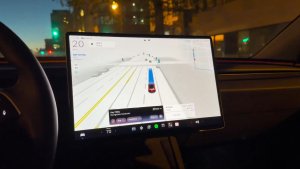
Whether it’s the harsh, low-angle light of dawn and dusk, or the glare of high beams at night, light saturation can render a camera or a pair of eyes temporarily useless. When a camera is blinded like this, though, FSD loses critical data, often leading to degraded performance, disengagements, or the dreaded red hands takeover warning on the screen.
For a Level 2 driver-assist system, this is an annoyance. But for a dedicated Robotaxi with no driver or even no steering wheel, it’s a critical failure point.
A newly published patent application from Tesla, titled “Cone-Textured Glare Shield for Enhanced Camera Vision” (US 2025/0334856-A1), reveals a sophisticated engineering solution to this problem. Tesla is developing a high-tech camera shield featuring light-swallowing micro-cones, and, even more surprisingly, a motorized mechanism to actively tilt a glare shield depending on the sun’s position.
The Physics of Glare
To understand the solution, we first need to look at the problem. Traditional glare shields in vehicles - the plastic housing you see around front-facing or fender cameras - are typically just flat pieces of textured plastic.
While they’re black to absorb light, they are still flat surfaces. When light hits them at a shallow angle (known as a grazing incidence), they can still reflect a significant amount of light directly towards a camera lens.
In optics, this is often measured by THR, or Total Hemispherical Reflectance. Even a matte surface can act like a mirror if the sun hits it at the wrong angle, washing out the image sensor.
Tesla’s patent notes that existing coatings and designs simply haven’t achieved the low THR values needed for optimal autonomous driving, and proposes a solution.
Micro-Cone Geometry
Tesla’s proposed solution replaces those flat surfaces with a complex, three-dimensional array of micro-cones.
Imagine the acoustic foam wedges used in recording studios to deaden sound. Now, shrink those thousands of times - Tesla is applying the same principle to diffuse light, but on a microscopic scale.
The patent details a surface covered in tiny, cone-shaped formations. These aren’t random bumps, but instead precision-engineered cones with heights ranging from 0.65mm to 2mm, and with sharp tips. These form a trap for incident light. It doesn’t bounce off; instead, it gets scattered between the walls of the cones until the energy is dissipated.

The result drastically reduces the THR, ensuring the camera can see the road rather than the reflection of its own housing. The patent also goes on to note that this micro-cone surface can also be coated with an ultra-black coating, similar to Vantablack or other carbon-nanotube-based paints, which works alongside the physical geometry to create a void-like surface that absorbs almost all incoming light.
A Moving Shield
Perhaps the most futuristic aspect of the patent is the description of an electromechanical adjustment system. Tesla isn’t just relying on static plastic; they are proposing a shield that moves, much like a human eyelid. The patent describes using stepper motors and actuators to dynamically tilt the glare shield in real time, based on sensing the precise position of the sun or other glare sources.
As you drive and the sun moves across the sky, or as the car turns a corner at night, the glare shield physically moves to maintain the optical angle for light diffusion.
The goal is to keep the camera lens permanently in the shadow, regardless of the time of day or the direction of travel. This helps to ensure sensor reliability and ensure consistent data intake.
Manufacturing Wizardry
Tesla is known for rethinking manufacturing, and this small part is no exception. You might wonder: how exactly do you mold plastic into millions of microscopic, sharp-tipped cones without them getting deformed, scraped off, or otherwise damaged?
If you try to inject plastic into a mold with such a shape, air will get trapped, and you’ll end up with blunt cones that don’t work well.
Tesla, however, has already proposed a solution as well. This uses sintered steel inserts, made from sintered metal. Although it appears solid, it allows air to pass through. By venting air through the mold steel itself, Tesla can form these sharp-tipped cones without issue.
Why This Matters
For a human driver, a sun visor or squinting is enough. But for a Robotaxi, “I couldn’t see because of the sun” isn’t an acceptable excuse for an accident or sudden disengagement.
This patent highlights the extreme level of detail Tesla is pursuing to solve the edge cases of autonomous driving. They aren’t just training neural nets - they are re-engineering to solve the physical challenges that can’t be overcome with software alone.
Removing glare reduces data noise, providing a cleaner and more reliable picture for FSD.
While we don’t know what will come of this patent quite yet, it is clear that Tesla is moving quickly to solve future challenges, and this technology may end up in future vehicles.