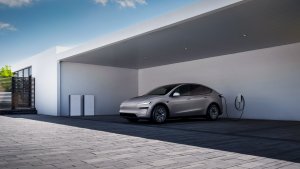
Tesla appears to be silently rolling out a significant change to its new V4 Supercharger stations: the removal of individual credit card terminals in favor of a centralized payment hub.
New photos and reports indicate that at select new V4 sites, the individual contactless payment readers, previously a hallmark of the V4 stall design, have been removed. In their place stands a single standalone kiosk that serves the entire cluster of chargers.
The New Centralized Experience

For the last year, V4 Superchargers have been rolling out with a small screen and a credit card reader built into every stall. This was a response to government regulations (such as the NEVI program in the US and similar laws in Europe) that require on-site payment options for drivers who don’t want to use an app.
However, at these new locations, those individual readers are gone. Instead, drivers who wish to pay by card must walk over to a central pedestal with a large touchscreen terminal. The interface prompts users to plug in their vehicle. Once plugged in, the terminal automatically detects that a vehicle is connected, but no session started via the app. The user then pays at the kiosk to authorize the session.
You can also use the kiosk to monitor your session.
Higher Kiosk Pricing

Perhaps the most critical detail for owners to note is the pricing. The user who spotted this new system reported that the price for paying at the kiosk was about double the existing Tesla rate.
Tesla already charges more for non-Tesla vehicle charging, though the Supercharging Membership brings it back down to Tesla rates through the app. Kiosk-initiated charging is likely a non-member rate that Tesla is charging, similar to other networks that offer discounts via an account, and further discounts via a subscription or membership.
By setting the kiosk pricing significantly higher, Tesla satisfies the minimal legal requirement to offer on-site credit-card payment, while heavily incentivizing users to download the app and create an account anyway.
Why the Change?
Moving to a centralized kiosk solves several headaches for Tesla. Credit card readers are notoriously fragile and are often the first part of a charger to break. Maintaining one central reader is far easier than maintaining 12 or 24 individual readers.
In addition, it helps Tesla cut costs by removing the high-security payment hardware from every post, significantly reducing build costs while still meeting compliance regulations.