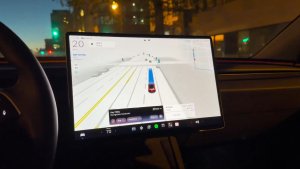
According to the updated Owner’s Manual for update 2025.44, the 2025 Holiday Update, Tesla now sets the default Speed Profile for new vehicles and for those activating FSD for the first time to Sloth Mode.
Previously, vehicles would default to Standard; however, given changes to FSD v14, both Chill and Standard will drive above the speed limit. Sloth, meanwhile, drives below the speed limit. The manual also now explicitly defines Sloth mode as “drives under the speed limit.”
Tesla has also defined each Speed Profile for the first time.
Default Speed Profile
It appears that the shift to Speed Profile that drives below the speed limit is a move to ease new users into the experience. If a vehicle starts driving above the speed limit, first-time users often feel nervous, wondering when it will stop. It can also be seen as a move to prevent potential issues with NHTSA.
This lets drivers build trust in FSD before they start experimenting with other drive modes. Just as before, once you change speed profiles, that profile will remain selected the next time you enable FSD, so new users can start off slow and calculated.
Speed Profiles Defined
The updated Owner’s Manual also introduces clear descriptions of the Speed Profiles, giving owners a better understanding of how FSD will drive in each mode.
Sloth: Model Y drives under the speed limit.
Chill: Model Y drives in slower lanes and makes minimal lane changes.
Standard: Model Y drives at normal speed and adjusts speed to match the flow of traffic.
Hurry: Model Y drives faster and makes more frequent lane changes.
Mad Max: Model Y drives more quickly than in the Hurry profile, with more frequent lane changes.
Otherwise, the vast majority of the updated owner’s manual related to FSD remains the same. These new descriptions help provide additional clarity to FSD’s Speed Profiles, which were previously only roughly defined in release notes.