In a series of posts on X, Elon Musk revealed an aggressive new hardware roadmap for Tesla. The ambitious plan deviates from Tesla's past, in which it has only updated FSD hardware every 4-5 years. Now, Tesla is planning much shorter, 9-month hardware cycles.
However, not all hardware will be for vehicles. It will include humanoid robotics, data centers, and eventually, orbital compute.
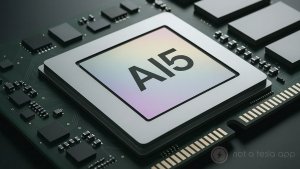
According to Elon’s latest updates, the final updated design for AI5 is almost done, while its successor, AI6, is already in the early stages of development.
But the real key here is the velocity and destination: Tesla plans to iterate through AI7, AI8, and AI9 with a cadence that would outpace the world’s leading chip giants - Intel, AMD, and NVIDIA.
AI4 by itself will achieve self-driving safety levels very far above human.
— Elon Musk (@elonmusk) January 18, 2026
AI5 will make the cars almost perfect and greatly enhance Optimus.
AI6 will be for Optimus and data centers.
AI7/Dojo3 will be space-based AI compute.
In response to questions about the necessity of so much compute power, Elon provided a generation-by-generation breakdown of exactly what each chip is designed to conquer. Today’s AI4 is focused on achieving self-driving levels far beyond human capabilities.
AI5
The first of the next-generation chips, AI5, will bring autonomy close to perfection and significantly expand Optimus’ capabilities for reasoning and understanding the world around it. That chip is still aimed for early 2027, roughly 12 months away.
AI6 No Longer For Vehicles
However, Musk now says that AI6 will be a chip dedicated to Optimus and Tesla’s data centers. This is a change from Tesla's previous statements, which mentioned that AI6 and future, more powerful hardware, would end up in Tesla’s vehicle lineup.
Now, it seems that AI5 will be the last major architecture and hardware jump for Tesla’s vehicles in the near future, with the remainder of the capacity dedicated to improving the neural nets that FSD runs on and improving Optimus.
While this seems like a letdown at first, it likely means that Tesla feels it can achieve level-5 autonomy in all weather conditions with AI5.
Finally, the wildest reveal of the thread was AI7. Elon has spoken previously about low-earth-orbit space-based AI compute, and it seems that the idea has grown from a literal Starship in the sky into a real idea that Tesla is planning to act on.
AI7 in Space
The mention of space-based AI for AI7 suggests that Tesla and SpaceX will continue deepening their relationship as companies under the Musk umbrella. As Starlink satellites become more capable and Starship enables massive payload deployments, putting inference compute in orbit is less far-fetched than it seems.
This would allow for edge-computing in space - processing satellite imagery, astronomical data, or complex communications directly in orbit without the latency of beaming data back to Earth. It would also enable cheaper computing for large, complex tasks, such as training AI neural networks.
One of the highest costs of training AI on the ground today is power and electricity, which are abundant in space. The challenges with cooling so much space-based compute are still real, but they’re definitely a constraint to work around, rather than a pure obstacle.
Moore’s Law on Steroids
For context, the traditional automotive industry typically operates on a 5- to 7-year hardware cycle. Even tech giants like NVIDIA, Intel, and AMD generally follow an 18- to 24-month cadence for major architectural leaps.
Tesla’s goal of a 9-month cycle is effectively unheard of for physical silicon. If achieved, it ensures that Tesla’s hardware will never be the bottleneck for its software. As the neural networks behind FSD continue to grow more complex, the car’s (and Optimus’) brain will continue to evolve in near real-time to support them.
The immediate fruit of Tesla’s labor on chips, AI5, is expected to be a monster capable of up to 40-50x the inference performance that AI4 is capable of today.
The Chip Volume King
Elon closed his statement with a bold prediction: Tesla’s silicon will become the highest volume AI chips in the world.
While NVIDIA dominates the high-margin server rack market, Tesla is playing a different game. By putting these chips in millions of cars - and eventually billions of Optimus robots - Tesla is building the world’s largest distributed inference fleet.
If Tesla does materialize their plan to use distributed inference to help train, that means a vehicle or robot on downtime and plugged in could help train models remotely, without needing to be physically co-located at a data center.
It seems like Elon’s idea of a Tesla Terafab to build chips is going to come sooner rather than later.
Seems to be the only option for super high volume
— Elon Musk (@elonmusk) January 18, 2026