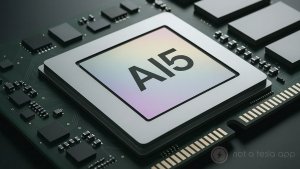
In an update from both Elon Musk and supply chain reports out of Korea, we’ve finally received some additional insight on the production and circumstances behind Tesla’s next-generation chip, AI5.
According to new reports from Korea, Samsung’s new foundry in Taylor, Texas, is scheduled to begin key equipment tests this March to prepare for the mass production of AI5 in the second half of 2026.
Tesla confirmed that AI5 will arrive in late 2026 with a “small number of units”, with high-volume production pushed back until 2027.
AI5 will be critical to advancing FSD, per Elon’s comments the other day.
Solving AI5 was Existential
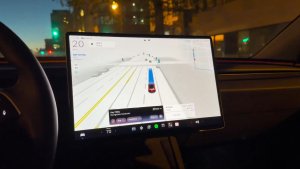
While the current AI4 computer is delivering impressive results with FSD v14 today, Elon admitted that Tesla’s future is effectively hinging on the success of its successor chip.
Solving AI5 was existential to Tesla, which is why I had to focus both the teams on that chip and I’ve personally spent every Saturday for several months working on it.
— Elon Musk (@elonmusk) January 19, 2026
This will be a very capable chip. Roughly Hopper class as single SoC and Blackwell as dual, but it costs…
The stakes were likely driven by the sheer compute density required for true unsupervised autonomy and the scaling of Optimus, Tesla’s humanoid robot. While both Elon and Tesla’s executive team have committed to bringing FSD Unsupervised to today’s current AI4 hardware, it seems that the additional processing power will be extremely useful going forward.
Tesla seems to be doubling down on its bet with AI4, as they’re currently intending on building production Cybercab units this year - equipped with AI4 chips, rather than AI5 chips. However, it waits to be seen whether these vehicles will be upgradeable to AI5.
Comparable to NVIDIA’s $30K Chip
For the first time, Elon also quantified the true performance of the new chip, based on other real chips today - NVIDIA’s industry-standard data center GPU, the H100 (Hopper), as the benchmark.
A single SoC AI5 will be roughly equivalent to one NVIDIA H100, while a dual AI5 system will be roughly equivalent to an NVIDIA B100/B200 Blackwell.
To put this in perspective, the NVIDIA H100 is a 700-watt, $30,000 server chip designed for a chilled data center. Tesla claims to have achieved roughly similar inference capabilities (for their particular FSD use case) in a package that fits behind the glovebox and runs off your low-voltage car battery - and costs far less.
If accurate, this means that every future Tesla Cybercab and consumer vehicle will carry a supercomputer equivalent GPU that rivals many of the most powerful AI server nodes today.
Made in Texas
With the AI5 architecture finalized and headed to the fab, Tesla’s silicon design team is already looking ahead. That means the “return” of Dojo, with Tesla’s Dojo 3 (AI6).
While AI5 will power the cars (and likely be the last major vehicle chip), Dojo powers the server and all the inference training. The implication here is that the hardware to run the neural nets is almost ready; now the focus is shifting back to the hardware that teaches those neural networks.