The history of Tesla’s Autopilot hardware is the story of a company slowly realizing just how hard it is to replicate the human eye and brain.
For over a decade, Elon Musk has promised that cars rolling off the line today have all the hardware needed for full autonomy. For over a decade, that claim has been walked back by the release of newer, sharper, and smarter autonomy suites. Today, we’re finally getting extremely close to true autonomy, but it's taken years, several hardware generations, and potentially more to come.
From the cyclops era of Tesla’s use of Mobileye to the distributed supercomputer future that is to come with AI5, here is how Tesla has evolved over the years.
Hardware 1: Mobileye
In the beginning… There was Mobileye. The original Autopilot hardware (AP1) was essentially an off-the-shelf driver-assist package found in other luxury cars. It relied on a single forward-facing camera and a Mobileye EyeQ3 chip.
It could see the lane lines in front of you and the car directly ahead, but was effectively blind to everything else. It had no concept of a stop sign, a red light, or a car merging into your blind spot. In short, this was the hardware that enabled TACC and lane-keeping, but little more.
At this early stage, Tesla also included radar and ultrasonic sensors (USS). The radar was used to track obstacles ahead of the vehicle that the single narrow-lens camera missed, while the USS sensors assisted the driver in parking the vehicle.
This hardware had a relatively short shelf life - from 2014 to 2017, when it was replaced with Hardware 2.0.
Hardware 2 & Hardware 2.5: Colorblind
Tesla ended its partnership with Mobileye in 2016, leading it to drop its hardware and software and build its own vision-based system from the ground up. At the time, HW2 was a colossal undertaking and introduced the new standard of 8 surround cameras, providing a near-360-degree view of your surroundings.
To maximize low-light sensitivity for the computer, Tesla used RCCC (Red-Clear-Clear-Clear) sensors. These cameras were excellent at detecting contrast, like lane lines and red lights, but they were effectively colorblind to everything else. If you view dashcam footage from this era, the world looks washed out and sepia-toned.
Rather than continuing with the EyeQ3 chip, Tesla jumped ship to NVIDIA’s Drive PX2, which struggled with processing all 8 video feeds simultaneously at full frame rates. However, this was the true start to Tesla’s work on autonomy.
In mid-2017, Tesla introduced a slight refinement known as Hardware 2.5. While the cameras remained largely unchanged, this update enabled a secondary node on the NVIDIA computer for redundancy—a critical safety measure. It also introduced a new Continental radar with a longer range.
This hardware was in use from 2016 to 2019, but many vehicles were upgraded to Hardware 3, the next iteration.
Hardware 3: Big Brain

This was the generation in which Tesla stopped using off-the-shelf parts once and for all. HW3 replaced NVIDIA’s PX2 chips with Tesla’s custom-designed HW3 FSD Computer.
The new computer jumped from ~20 TOPS with PX2 to 144 TOPS, allowing Tesla to finally process all 8 cameras at full frame rates and full resolution. Alongside the new compute, Tesla also included 1.2-megapixel sensors that saw in tinted color for the first time, but they lacked resolution to see at a distance and to read things like signs effectively.
However, as we know today, this still wasn’t nearly enough new power to achieve FSD Unsupervised. Today, Tesla stands on their commitment to deliver FSD v14-Lite to HW3 owners, and upgrade their vehicle computers in the future once they achieve true autonomy with AI4 - the current generation of hardware.
Tesla also began dropping the radar from its lineup with HW3. Newer Model 3 and Model Y had no radars, while the Model S and Model X shipped with them - deactivated - for quite some time.
In the middle of HW3’s life, Tesla also stopped including the USS sensors, swapping to Tesla Vision for the first time.
HW3 had the longest life to date, from 2019 to 2023, before being replaced by today’s current hardware.
Hardware 4 (AI4): Big Brain 2: High Definition

Hardware 4, also known as AI4, was the moment Tesla finally made massive upgrades to FSD’s eyes, and also upgraded the compute to match. The cameras jumped from 1.2MP to ~5MP, giving the car something much closer to 20/20 vision. Tesla also included true color vision with RGGB sensors in HW4, ensuring accurate color reproduction.
In more recent versions of this hardware, Tesla now includes a front bumper camera, pioneered by the Cybertruck and now included across the entire refreshed lineup. The bumper camera helps fix the front blind spot in front of the vehicle's bumper, which is especially key during precise low-speed maneuvering, like in a parking lot.
Now, Tesla appears to be making further changes, such as the inclusion of a rear camera washer for the first time on a Tesla vehicle, spotted on Cybercab prototypes in Austin, Texas, but these changes haven’t been seen in production vehicles yet.
Hardware 4.5

Tesla has revealed an upgraded version of its current AI4 computer, internally referred to as AI4+ or HW4.1. The new computer serves as an intermediate step between today’s AI4 hardware and the much more powerful AI5 platform expected later.
The biggest change is memory. Current AI4 computers contain 16GB of RAM per SoC (32GB total across Tesla’s dual-chip architecture). AI4+ doubles that to 32GB per SoC, resulting in 64GB of total memory. This gives Tesla significantly more room to run larger neural networks and future FSD models without immediately requiring AI5 hardware.
In addition to the memory increase, Tesla says AI4+ will deliver approximately 10% higher compute performance and 10% higher memory bandwidth.
Tesla stated that HW4+ is slated for mid-2027.
AI5: Distributed Supercompute

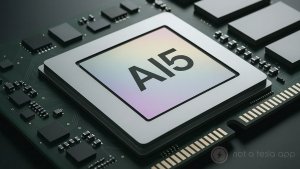
AI5 (also referred to as HW5) is Tesla’s next-generation AI computer, and it’s designed to succeed the current AI4/HW4 hardware. AI5 will be Tesla’s largest leap in FSD hardware since it introduced its first in-house FSD computer in 2019.
Tesla is targeting 2,000–2,500 TOPS (trillion operations per second), compared to roughly 500 TOPS for AI4. This competes with top-end consumer graphics cards, as well as NVIDIA’s own datacenter cards like the H100.
That’s approximately 3–5x more compute power than AI4, although Tesla executives and Elon Musk have suggested certain AI workloads could see much larger gains.
AI is extremely memory-hungry, as evidenced by the doubling of memory in the upcoming AI4+ computer, but AI5 could see Tesla increase memory by 9x.
While many owners are looking forward to AI5, it’s not initially destined for Tesla vehicles. Tesla stated that it will first appear in Optimus and vehicles will eventually receive AI5 in late 2027. However, given Tesla’s timeline for AI4+, we would expect one of these timelines to shift; either AI4+ arrives earlier than expected, or AI5 for vehicles gets pushed to 2028.
The Path Forward
Tesla’s hardware history is a lesson in necessity over sufficiency. Every generation except AP1 was sold as the final piece of the puzzle, only to be revealed later as a stepping stone. To be fair, Tesla has admitted that autonomy has been much more difficult to solve than they expected.
Tesla appears to finally be on the brink of solving FSD with the advancements in FSD v14 and AI4. However, we now know that AI4 isn’t the last hardware generation. There will be an AI4+ and eventually an AI5.
While the computing power in AI4+ and AI5 is known, the cameras and camera cleaners for these newer generations are still anyone’s guess.