For years, owners have relied on third-party APIs or Home Assistant integrations to get specific behaviors in their vehicles. While Tesla often adds automations, such as enabling the vehicle’s climate when it’s parked and reaches higher temperatures (Cabin Overheat Protection), they’re now giving users the ability to create their own automations.
This new Automations app is a logic engine that lets users customize behaviors using the simple, easily understandable “If This, Then That” logic.
We previously looked at the release notes for this feature here, but we now have a quick overview of how the feature works and some of the events and actions that will be available.
Automations
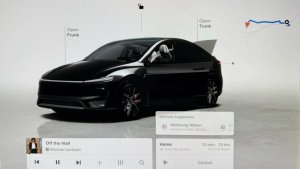
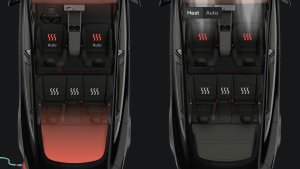
Based on a sketch provided by a source familiar with the software in China, the user interface uses a grid layout, with each automation represented as a card that can be enabled or disabled.
Tesla includes several default automations to give you an idea of what’s possible, but users can dig into a huge set of events and actions to create their own automations.
When creating a new automation, Tesla puts triggers and actions into categories. Selecting a category will reveal the triggers and actions available. Categories will include seat heating/cooling, doors/windows, charging HVAC, media, and more.
The Conditions (Triggers)
The app allows users to initiate an automation based on a wide variety of vehicle states and environmental factors.
This includes a long list of vehicle triggers, such as gear changes, specific speed thresholds, seat-occupancy sensor status, and seat-belt status, among others. For environmental states, it’s just as extensive a list, including time of day, outdoor light level, cabin temperature, outdoor temperature, and Air Quality Index (AQI), among many others.
Among the triggers are also user-selected voice commands. This, in particular, may be an interesting stepping stone for feature development, as China uses a region-specific smart assistant, while North America integrates Grok, with Europe and other parts of the Indo-Pacific region expected to have access to Grok in the future. This voice trigger lets users create custom voice commands and have the vehicle perform specific actions.
The Actions
Once a condition is met, the car can execute specific hardware and software commands. This can include adjusting the temperature or HVAC settings, adjusting interior lighting (likely the dome lights and potentially the ambient lighting), adjusting driving dynamics on the fly, or providing feedback via user-customizable text-to-speech. For example, you could have the vehicle greet you with a custom message whenever you sit down.
Create Features We’ve Wanted for Years
While these may seem pretty simple at first, for power users or anyone interested in automating their car, there’s a lot to unpack.
Take the Air Quality Index (AQI) condition. Currently, users must manually toggle Bioweapon Defence Mode after checking the AQI themselves. That’s a rather reactive procedure, but with the new Automations app, you can set a simple rule. If Outdoor AQI > 150, Then Enable Bioweapon Defence Mode.
Similarly, the vehicle’s speed state could be used to adjust driving dynamics on the fly. If you’re going fast on a highway, maybe you’ll want to shift to Sport or Plaid mode automatically, and include a voice note remind you that you’re entering Plaid Space.
One of the demos includes a voice note that audibly announces “Gear Shifted” when the driver moves from Park to Drive or Reverse, which could be fantastic for those unfamiliar with Tesla’s UI or older folks who are forgetful.
Guardrails & Limitations
However, Tesla isn’t giving users total carte blanche. There is a safety limitation already baked in, and likely more coming. At the moment, Automations cannot be triggered or executed while Autopilot or FSD is active.
The restriction is fairly logical. Tesla cannot risk a user-created script interfering with driving dynamics, like changing the mode from comfort to sport on the fly during a high-speed highway overtake.
Tesla is also limiting the triggers and actions to a list that they feel is safe and not every vehicle option is available.
Less Feature Requests, More Tasker APIs
Historically, Tesla’s software development has operated like Apple: “We know what you want better than you do.” If you wanted the car to turn on the heated seats automatically at a certain exterior temperature, you had to wait for Tesla to push a feature update that added that specifically. The same applies to enabling Bioweapon Defense Mode. Now Tesla is giving users the power to do this, rather than filling their menus with a variety of options.
With the Automations app, Tesla is effectively democratizing feature development for quality-of-life features. It solves the Long Tail of user requests, the niche desires that aren’t popular enough for a global fleet update, but are crucial to individual owners.
If a parent wants Chill mode engaged automatically whenever the rear seats are occupied and buckled, they can now build that additional safety feature with a few taps on the screen.
This feature is releasing in China soon and is expected to become available in other regions in a later software update.