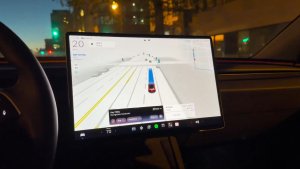
Tesla’s FSD visualizations have steadily gotten more and more detailed, and the latest addition is strictly for equestrians. A recent sighting confirms that FSD can now accurately render horses in the driving visualization, checking off another unique edge case on the road.
This addition comes on the heels of a recent asset update that added 15 new FSD visualizations, including ambulances, police cars, fire trucks, vulnerable road users, and even golf carts. However, they have yet to be enabled for everyone. What’s interesting is that at the time these new 3D models were discovered in the firmware, there were no additional animal models included, making this a recent addition.
We have received other reports of some users seeing golf carts visualized, but they haven’t been enabled for everyone.
Hold Your Horses
The new visualization, spotted on the streets by Scotty4Scott, clearly shows a horse trotting alongside the vehicle. While Tesla has long been able to detect pedestrians and dogs, it often renders larger animals as dogs or humans. While these new 3D models are already in the firmware, Tesla can likely turn on rendering of these assets remotely.
While it’s important that the vehicle recognizes there’s an object in the way, as reasoning comes into play, it becomes more important to correctly identify the object.
Not Horsing Around
While a 3D horse model looks cool, its presence implies that we’ve started seeing some more of what lies under the hood with FSD’s reasoning abilities. If FSD’s visual recognition can specifically label an object as a “horse” rather than a generic obstacle, it can apply a distinct behavioral policy and reason around its existence.
Unlike a pedestrian or a car, a horse can be skittish, unpredictable, and easily spooked by loud noises or close passes. By properly classifying the animal, FSD can adjust its planner to take the correct speed and offset around the horse, ensuring that it isn’t treated the way it would closely pass a car.
For drivers in rural areas, Amish communities, or cities with mounted police, this is a welcome visual confirmation that the car sees the animal correctly - and understands it isn’t just a strangely shaped pedestrian.