Tesla’s transition from an automotive manufacturer to an AI services hub has certainly taken the world by storm in recent weeks. However, Tesla’s Energy division remains one of the company's fastest-growing divisions and it’s about to take another leap.
Tesla is officially launching the Powershare Grid Support program in Texas. The Cybertruck will now be capable of not only powering your home or jobsite but also the local grid. This is the first time Tesla has ever enabled true Vehicle-to-Grid (V2G) functionality.
Virtual Power Plant 2.0
For years, Tesla’s Virtual Power Plant (VPP) has relied on the stationary Powerwall to provide grid-tied services. While effective, the sheer scale of the Cybertruck’s 123kWh battery pack, roughly equivalent to nine standard Powerwalls, dwarfs the potential of the existing Powerwall units, which customers have one or two of.
By enabling V2G support, Tesla is allowing owners to act as a massive, distributed energy storage resource that can be called upon during peak-demand events with the same millisecond-level precision used for VPP activities.
Unlike traditional peaker plants that take time to ramp up, VPPs can respond to grid stress in real time. This enables a bidirectional exchange in which your Cybertruck actively contributes to power grid stability and earns you bill credits along the way.

Starting in Texas
It is no coincidence that this rollout is starting in select Texas markets served by CenterPoint Energy and Oncor. The Texas grid (ERCOT) is isolated and historically prone to extreme volatility. By enrolling in the Tesla Electric Drive plan, Cybertruck owners can provide grid stability and earn bill credits while their vehicle is parked and plugged in at home - effectively letting the battery do the work.
Participants will receive compensation for discharging energy during high-demand events, which often occur with little notice. This creates a financial incentive for owners, as these high-demand events pay the most when the grid needs energy.
How It Works
One of the primary concerns for V2G adoption has always been the fear of being left with a depleted battery when you need to drive. Tesla has addressed this in the same way Powershare V2L and V2H currently work. You can now set the maximum discharge limit to whatever you’d like, letting you save power for your own home or for when you need to drive.
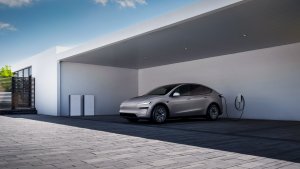
Of course, you’ll need to meet a certain set of conditions to be able to enroll in the program. You’ll need a Cybertruck, as well as the Powershare Gateway and Universal Wall Connector. This enables not just V2H, but also V2G. Once that’s done, you can enroll in the Electric Drive via the Tesla App and opt in to Powershare Grid Support.
The Grid of the Future
While the program is starting off in Texas, it will be expanding to California in the near future, for areas serviced by PG&E, SCE, or SDG&E. This is Tesla’s proving ground for the service, similar to how they proved VPP’s capabilities through slow rollouts before they expanded the program immensely.
Today, VPP has such an impact on grid stability that it often keeps the grid functional in Puerto Rico, which has historically suffered from energy stability issues due to the island’s geography.
This is another way Tesla is helping improve grid stability and a step toward using its vehicles to achieve its goal of Amazing Abundance.