China is taking a heavy-handed approach to automotive design, both on the exterior and interior of vehicles. Now, the latest set of changes from the country might just spell the end for the ultra-minimalist, screen-dominated cabins that have defined the modern EV era.
In a push for increased safety, regulators are stepping in to mandate the return of physical buttons and effectively outlaw the yoke-style steering wheel.
Turn Signal, Gear Selector and More
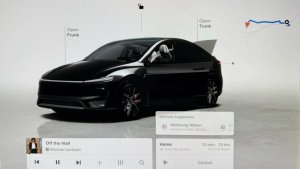
According to newly drafted regulations from China’s Ministry of Industry and Information Technology (MIIT), automakers like Tesla have taken the touch-screen focus too far. Starting in 2027, essential safety and driving functions must be controlled by physical buttons or switches that are easily accessible by drivers. The list currently includes gear selectors, turn signals, hazard lights, and emergency calling (eCall) features.
These are not just loose guidelines either. The mandate requires these essential controls to have a minimum surface area of 10mm by 10mm (⅜ inch x ⅜ inch) and provide clear tactile or auditory feedback to the driver when used.
This effectively bans burying critical functions in touchscreen submenus or relying on flat, haptic-capacitive panels that provide no physical feedback. It is a challenge to the interior design philosophy that has been popularized by Tesla, and heavily adopted by many other automakers, as well as Chinese giants like BYD and Xiaomi.
The Physics of the Yoke Ban
While the return of physical gear selectors and turn signals will please many drivers, the most dramatic casualty of these new regulations is the yoke steering wheel.
The Chinese government isn’t banning these on pure aesthetics, but instead, as a matter of physics and crash test dynamics. The new safety standard (GB 11557-202X) strictly updates the rules for protecting drivers from steering mechanism injuries. To pass compliance, a steering wheel must now undergo testing at 10 specific points around its rim.
For a yoke, the top half of the rim simply does not exist. This missing physical structure makes it impossible to conduct the mandated upper-rim impact tests, automatically resulting in a failure to comply. Regulators highlighted severe safety risks, beginning with the fact that a traditional round wheel acts as a large buffer zone.
That means that without a full upper rim, a driver's body can slip past the wheel during a collision and strike the dashboard. Regulators also noted that the yoke's irregular shape and support structure create unpredictable, potentially dangerous airbag deployments.
Global Ripple Effect
Because China is the world's largest automotive market, these localized regulations will undoubtedly force a global design reset. Automakers simply cannot afford to design and manufacture entirely separate China-only dashboard architectures at scale.
For Tesla, which arguably started both the minimalist trend and the yoke trend, the impact of the ban might be surprisingly muted. Tesla already brought back turn signal stalks, and we could see a return of the gear stalk (although the backup PRNDL buttons (near the dome lights on the Model 3/Y and near the phone chargers in the S/X) may comply with regulations).
With the Model S and Model X production ending, the original yoke is already headed for retirement. As for the Cybertruck, its squircle steering wheel should theoretically pass the new Chinese standards. Unlike a yoke, it features a fully enclosed, continuous rim that provides the necessary physical impact points for crash testing.
While this regulation is still in the draft phase, we expect that auto manufacturers, including Tesla, are likely already beginning preparation for the changes to come online within the next couple of years.
China recently banned electric-only door handles, which will affect the design of the Model 3 and Model Y.