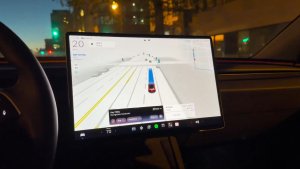
As Tesla pushes closer toward achieving unsupervised autonomy, it recently released its newly updated Vehicle Safety Report. Encompassing the latest 12 months of collision data across all North American road classes, the numbers reveal something that won’t surprise those who use FSD every day.
There’s a widening safety gap between human drivers and artificial intelligence, and it's growing faster than ever.
NEWS: Tesla has released new FSD (Supervised) safety data.
— Sawyer Merritt (@SawyerMerritt) February 18, 2026
Total major collisions:
• Teslas with FSD (Supervised): 830
• Teslas driven manually with Active Safety: 16,131
• Teslas driven manually without Active Safety: 250
• U.S. average: 4,989,713
Miles per major… pic.twitter.com/KnId83gXXb
Alongside the new safety metrics, Tesla also confirmed a staggering new milestone. The global fleet has now officially surpassed 8.2 billion cumulative miles driven on FSD. To put that in perspective, Voyager 2 has gone approximately 13.2 billion miles from Earth, and Mars is only a paltry 220 million miles away.
The Safety Breakdown
To provide an objective look at vehicle safety, Tesla’s report tracks major collisions - which are strictly defined as impacts severe enough to deploy airbags, seatbelt pyro restraints, or set off the high voltage battery pack pyro fuse.
Tesla then breaks this data down into distinct categories to compare how FSD stacks up against human drivers and the overall national average.
Miles Driven Per Major Collision:
Teslas with FSD (Supervised): 1 crash every 5,300,676 miles
Teslas driven manually (With Active Safety): 1 crash every 2,175,763 miles
Teslas driven manually (Without Active Safety): 1 crash every 855,132 miles
U.S. Average: 1 crash every 660,164 miles
Data doesn’t lie: Teslas operating with FSD engaged (and an attentive driver) experience significantly fewer collisions than those driven manually. In fact, a Tesla on FSD goes over eight times further between major accidents than the average vehicle in the US.
Even when humans take the wheel, Tesla’s underlying safety technology continues to protect them. Manual driving with Tesla’s standard active safety features, like Automatic Emergency Braking and Lane Departure Avoidance, still results in a crash rate that’s three times better than the national average.
Teslas in the “Without Active Safety” category are from pre-2014 - those without any active safety systems.
These numbers are up over last year in the FSD category, when Tesla reported 1 crash every 5.1 million miles for a vehicle using FSD. The numbers are down for Tesla vehicles being driven manually. Last year, Tesla reported 1 crash every 2.3 million miles with active safety features and 1 crash every 927k miles for Teslas without active safety features. However, some natural variance is expected.
Data Scope
One of the most frequent criticisms of Tesla’s safety features and autonomy data is that it relies on small sample sizes. However, the sheer volume of telemetry that Tesla used for this 12-month report is practically unrivalled in the automotive industry.
Total Miles Logged (Latest 12 Months):
Teslas with FSD (Supervised): 4.39 billion miles
Teslas driven manually (With Active Safety): 35.09 billion miles
Teslas driven manually (Without Active Safety): 213.78 million miles
U.S. drivers overall: 3.29 trillion miles
From those billions of miles, Tesla recorded just 830 major collisions while FSD was engaged, compared to over 16,131 major collisions from manually driven Teslas. Non-Tesla vehicles had a staggering 5 million recorded incidents, on average, across the broader US.
Crucially, this data isn’t cherry-picked from the sunny highways of California or Texas. It encompasses all road classes in North America, including complex city streets, rural roads, and unmarked intersections. Plus, if FSD was active at any point within five seconds prior to an impact, Tesla counts it as an FSD collision.
8.2 Billion Miles and Counting
These impressive safety metrics arrived alongside a massive milestone. Tesla officially confirmed that owners have now driven over 8.2 billion miles on FSD (Supervised).
This number is more than just a bragging right. It is the essential training data that Tesla uses to further refine FSD - edge cases, weather data, unpredictable human behavior - fed back into the neural networks to train them.
Elon Musk previously estimated that roughly 10 billion miles of training data is the estimated threshold required to achieve true, unsupervised autonomy. Given the accelerating rate of accrued miles, Tesla is on track to exceed that number very soon.