Winter driving has always been the Achilles’ heel of electric vehicle efficiency, as blasting the defroster to clear the windshield can eat into your vehicle’s battery range quickly. Now, Tesla has patented a new trick to try to solve that problem.
In a newly published patent application titled "Automotive Glazing Heating System with Independent Zone Activation" (US 2026/0046983 A1), Tesla outlines a highly efficient, targeted approach to windshield heating. Instead of warming the entire sheet of glass, the system isolates and heats only the specific zones that actually need it.
Let’s take a look at exactly how this new patent will maximize efficiency - and also keep your windshield clean.
The Problem with Current Defrosters
Traditional automotive heating systems are relatively blunt instruments. They utilize uniform heating elements embedded in or applied to the glass to defrost or defog the entire pane at once.
For an EV, this lack of precision presents some major challenges. Heating an entire windshield requires a significant amount of energy, leading to massive, unnecessary low-voltage power consumption.
In addition, the metallic coatings often used in these traditional heating systems can interfere with the signal transmission of embedded antennas and reduce optical clarity when placed near cameras. You can read about how Tesla intends to solve at least part of those two particular problems with another patent on printed circuit glass here.
How Zoned Heating Works
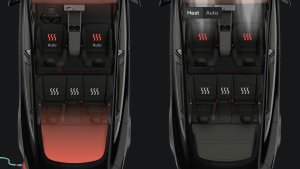
Tesla’s proposed solution replaces the uniform heating element with a conductive layer that is segmented into multiple distinct heating zones, spread across your windshield.
These zones are physically and electrically isolated from one another by precise, unheated gaps. These gaps would be created during the glass manufacturing process, potentially through laser ablation, mechanical etching, or masking processes detailed in the patent.
The key here is that each of these independent zones draws power individually. According to the patent, each zone has its own dedicated set of bus bars to supply it with electrical power, ensuring that only the zone that needs defrosting or defogging is powered, rather than the whole thing.
Finally, a central control unit will manage the entire zonal system, capable of activating specific zones based on real-time data. The system will be able to trigger zonal heating based on manual user inputs, real-time weather conditions, vehicle speed, and data from vehicle sensors.
Precise Efficiency for Cameras & Wipers
While one of the larger heating zones can be activated to cover the driver’s general field of view, the true genius of the patent lies in its smaller, specialized zones.
The patent highlights a specific heating zone positioned exactly to match the field of view of your Tesla’s forward-facing cameras. If onboard sensors detect moisture, ice, or fog interfering with the cameras, the control unit can instantly activate just that specific zone to clear the glass. That ensures uninterrupted operation of FSD - even if your windshield is covered in snow.
After all, when no humans are driving, there is no need to clear the whole windshield of snow or fog.
Similarly, Tesla details additional targeted heating zones located exactly where the windshield wipers rest. The system could automatically activate these specific lower zones when temperatures drop, preventing the wiper blades from freezing to the glass.
Tesla already implements wiper heaters, which warm a portion of the windshield to prevent it from sticking. This new patent simply integrates that existing concept into a much more advanced, windshield-wide zonal system, completely isolating it from the rest of the pane.
The Bigger Picture
When combined with the patent on Printed Circuit Glass, you can see where Tesla is going with this. By printing conductive traces directly onto the windshield to eliminate wiring harnesses and heat only the portions of the glass that need heating. It's all about efficiency in both manufacturing and operation. As Tesla moves into owning the vehicles themselves through the Robotaxi network, efficiency plays an even larger role, since these vehicles become even cheaper to operate, whereas the consumer would normally eat this cost.
In short, Tesla is rethinking many of the old legacy systems one step at a time, working to optimize where every single watt of energy from your battery goes. By acting like a surgeon’s scalpel rather than a butcher’s knife, Tesla can conserve battery range while guaranteeing that FSD hardware remains fully operational even in harsh environments.