When SpaceX first announced its Direct to Cell Starlink program, the general expectation was that the service would primarily serve as a basic emergency backup. It would provide SOS texts and slow messaging when you ventured completely off the grid, as a lifeline and means to maintain connectivity.
According to new details shared by SpaceX, it is now aiming to beam high-speed 5G connectivity directly to unmodified cellular modems from space, bypassing terrestrial cell towers entirely. If successful, this breakthrough could change the telecom landscape - and also unlock an even better version of Premium Connectivity for Tesla.
Link Budget
Speaking this week at the International Telecommunication Union’s Space Connect conference, SpaceX satellite policy lead Udrivolf Pica outlined the ambitious new benchmark being set for Starlink Direct to Cell.
“We are aiming at peak speeds of 150Mbps per user,” Pica stated. “So something incredible if you think about the link budgets from space to the mobile phone”.
To put that in perspective, the current iteration of cellular Starlink tops out at an estimated 4 Mbps per user. That’s barely enough for low-resolution video and basic web browsing. Jumping to 150 Mbps doesn't just improve the service; it elevates it to a true competitor against terrestrial telecommunications networks. For context, median download speeds for terrestrial 5G networks currently sit at 172 Mbps for AT&T and 309 Mbps for T-Mobile.
To achieve this massive leap in capacity, SpaceX is preparing to leverage newly acquired radio spectrum from EchoStar. This broader spectrum acts as a larger data pipeline, enabling true broadband use cases like high-definition video streaming straight from Low Earth Orbit.
Enhancing Premium Connectivity
While this is a game-changer for smartphone users in rural areas, the implications for Tesla’s ecosystem are equally as large.
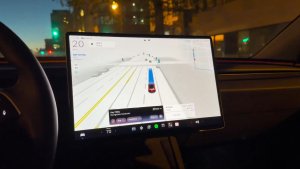
Currently, Tesla relies on partnerships with traditional terrestrial cell carriers (such as AT&T in the United States) to power its Premium Connectivity features, including live traffic visualization, music streaming, and more. Because these carriers rely on physical cell towers, Teslas are still subject to frustrating dead zones in rural or mountainous regions.
If SpaceX can consistently deliver 150 Mbps to a standard cellular modem without a dedicated, bulky Starlink dish, Tesla could theoretically integrate this exact Direct to Cell technology directly into future vehicles, likely with little to no changes from current vehicle modems.
Plus, migrating the Tesla fleet’s cellular data expenses from third-party contracts over to SpaceX would keep millions of dollars in recurrent subscription revenue entirely within the Elon Musk ecosystem - netting another big win for SpaceX and Tesla both.
Looking Over the Horizon
SpaceX aims to launch this upgraded cellular Starlink service in late 2027, coinciding with the finalization of the EchoStar spectrum deal. While legacy carriers aren't going extinct tomorrow, the prospect of 150 Mbps beaming directly from space brings Tesla one step closer to building a truly untethered, fully connected autonomous vehicle.