When we talk about Tesla’s FSD, the conversation usually revolves around navigating tricky unprotected left turns or handling city intersections. But a recent highway incident involving the latest FSD v14.2.2.5 build highlights a completely different, and arguably much more important capability: predictive collision avoidance at highway speeds.
In a terrifying near-miss scenario, FSD didn’t just react to an accident that was about to play out in front of it - it predicted it before it happened and proactively moved out of the danger zone.
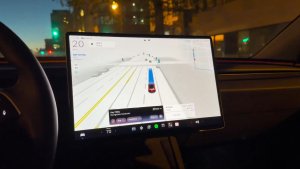
Model Y on FSD (Supervised) v14.2.2.5 identifies a possible collision ahead of the car in front of it and reacts accordingly. pic.twitter.com/oMX3Ptf23J
— Sawyer Merritt (@SawyerMerritt) February 26, 2026
The 70mph Close Call
The incident occurred at highway speeds just shy of 70 mph. The Model Y, running FSD v14.2.2.5, was travelling behind another vehicle in the left lane when an oncoming car suddenly drifted across the center boundary line, setting up a catastrophic, high-speed head-on collision with the lead vehicle.
Any other advanced driver assistance system (ADAS) would just react to the vehicle immediately in front of them. If the lead car slams on its brakes, the ADAS slams on its brakes too. But FSD did something entirely different.
Instead of waiting for a collision to occur and then panic-braking, the neural net instantly realized the trajectory of the rogue oncoming vehicle. It calculated the real and imminent threat of a head-on crash ahead, and before the two cars even crossed paths, FSD autonomously executed a lane change to clear itself away from the potential collision radius.
Zero Intervention Required
Thankfully, the two vehicles ahead managed to narrowly avoid each other at the absolute last second, meaning no actual collision occurred. But FSD’s reaction was utterly flawless.
By proactively switching lanes, FSD ensured that even if a horrific 70 mph crash had occurred right in front of it, the vehicle and its own occupants were already safely out of the way of the majority of any flying debris or secondary impacts.
The best part? Once the danger had passed, FSD simply continued routing down the highway normally, without requiring a single human intervention.
The Power of End-to-End
This scenario perfectly illustrates why Tesla’s transition to a single, end-to-end neural net for both city and highway driving is such a massive paradigm shift for autonomy.
Older, heuristics-based stacks relied heavily on hard-coded rules (stay between the painted lines, maintain distance from the vehicle ahead). FSD’s neural networks don’t rely on rigid code. It instead operates on a pure video-in, controls-out logic, trained on millions of miles of human driving data. It understands the physical reality of the world around it.
FSD didn’t just see a car crossing the painted line; it understood the physics of two objects hurtling towards each other at high speeds, and immediately knew that the safest place to be was somewhere else. Tesla’s work towards bringing proper reasoning to FSD is really shining here.
As Tesla continues to refine FSD, we expect to see even more of these predictive safety maneuvers, proving that FSD is rapidly changing from a convenience feature into a hyper-vigilant vehicle operator that is growing to be safer than humans.