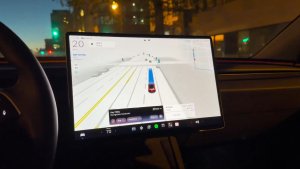
Tesla is proving that its artificial intelligence can learn the "unwritten rules" of the road, even those it wasn't explicitly taught. In a recent video shared by DirtyTesla, a Tesla vehicle running the latest Full Self-Driving (Supervised) version 14.2.2.5 was caught performing a human-like maneuver.
"Look how FSD scoots over to put the pothole under the car and avoid the tires," the creator noted while sharing dashcam footage of the incident. The car identified a pothole in its path and made a slight, fluid adjustment to its trajectory on the fly. Instead of hitting the dip, the car steered both tires clear, straddling the pothole so that it passed harmlessly under the chassis.
Look how FSD scoots over to put the pothole under the car and avoid the tires 🤯🤯🤯 pic.twitter.com/J3w3dnzJUP
— Dirty Tesla (@DirtyTesLa) March 5, 2026
FSD’s Newfound Ability to Avoid Potholes
This pothole avoidance is another milestone for FSD’s end-to-end neural network. Unlike traditional software that relies on hundreds of thousands of lines of code to handle specific scenarios, the latest iterations of FSD learn from millions of video clips of human driving.
Even if Tesla engineers didn’t specifically train FSD on "pothole avoidance", the system has seen enough humans dodge road imperfections to mimic the behavior. This often involves the car making smooth lateral movements, sometimes even crossing a yellow line when the road is clear, to protect the suspension and tires. We’ve observed this behavior firsthand, with FSD crossing over a yellow line to avoid a large pothole on a one-lane road when no traffic was around. It is a level of environmental awareness that makes the system feel much more natural and less like a rigid computer.
Why It Won’t Always Work
It’s important to note that FSD is likely not specifically trained for these scenarios, such as avoiding potholes. It’s likely that learning them comes from being trained on millions of videos of how drivers react to their surroundings. What this means is that while it may avoid a pothole in one area, it may not in another, because it just doesn’t have enough training data to handle most scenarios.
This was the same case with toll booths. Tesla’s VP of AI explained why this works and that Tesla hasn’t specifically trained this behavior into the neural network. The training process had seen enough examples of toll booths that it knew to stop, even when there wasn’t a gate in the way. When the cameras see a hand out of the window, they understand drivers stay stopped, but when the hand comes back in, it learns that most drivers start to accelerate. Tesla’s AI models are essentially copying human behavior, and the more video examples you give it, the more scenarios it’ll understand.
Tesla focuses on the important areas first, like identifying and stopping at a stop sign, but one day it’ll actively train on less important details like potholes.
Beyond the Pothole: Smarter Real-World Interactions
Pothole dodging is just the latest in a string of impressive, unscripted improvements. FSD has recently been spotted handling toll booths with surprising competence, coming to a stop and waiting for occupants to finish their transaction before proceeding. It has also gained the ability to recognize hand gestures, such as a worker at a construction site or a cyclist waving the car forward.
The system is also becoming more responsive to driver intent. If you want the car to take a different path than the one mapped out, you can now sometimes use your turn signals to nudge the AI into making an uncharted turn. This is in addition to FSD's documented ability to predict and avoid high-speed crashes before they even happen.
The Road to Unsupervised Autonomy
As Tesla works toward a version of FSD that no longer requires a human supervisor, the machine learning behind it is clearly outperforming expectations at times. Elon Musk recently announced that users will soon be able to control FSD with Grok, Tesla’s built-in AI assistant. This would allow you to use natural language to tell the car exactly where or how you want to park when you arrive at your destination.
With every update, FSD is becoming more confident and capable of handling edge cases that once seemed impossible. By learning from the collective experience of millions of miles driven by humans, Tesla is creating an AI that understands the nuances of the road better than any programmed system ever could.