Tesla is officially moving into a new era of charging infrastructure. The company’s Gigafactory in New York has just reached a major milestone by assembling its final V3 Supercharger cabinet, signaling a total shift in production toward the next-generation V4 hardware.
According to the official Tesla Charging account on X, the factory built more than 15,000 V3 cabinets over a seven-year span. With that production line now retired, the focus has shifted entirely to ramping up the V4 cabinet line to meet the needs of an increasingly diverse electric vehicle market.
The End of the V3 Supercharger Era
The V3 Supercharger was the backbone of Tesla's global charging expansion for years. It introduced the 250kW charging speeds that most Tesla owners are familiar with today, allowing for roughly 200 miles of range to be added in about 15 minutes.
While the V3 system was revolutionary when it arrived, it was primarily designed for Tesla's 400V vehicle architecture. As the industry moves toward higher-voltage systems and larger vehicles like the Cybertruck, the hardware needs a fundamental upgrade to keep up with the power demands.
The Rise of the V4 Cabinet
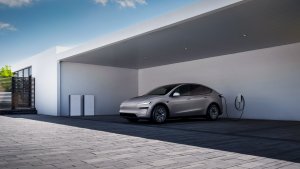
The transition to V4 isn't just about a new look; it’s a complete overhaul of the power electronics. A V4 Supercharger setup consists of the V4 stall, which features a longer cable and a more powerful cabinet. Some stalls will use an ergonomic, easy-grip handles for better accessibility and payment terminals so a Tesla account isn’t necessary.
The new cabinets are a massive step forward in efficiency and speed. One V4 cabinet can now power up to eight charging stalls, which is double the capacity of a V3 cabinet. This smaller footprint and reduced complexity mean Tesla can deploy new sites faster and at a lower cost — reportedly under $40,000 per stall.
On the performance side, the V4 system supports vehicle architectures from 400V all the way up to 1000V. This enables charging speeds of up to 500 kW for passenger cars. Currently, the Cybertruck is the only vehicle in Tesla's consumer lineup with an 800V architecture capable of fully utilizing these higher speeds, while the S3XY family gets the same 250 kW charging speeds as V3 Superchargers. Check out our full deep-dive into Tesla’s V4 Superchargers for more info about them.
A Better Experience for Everyone
Tesla has also been working to make charging at V4 stalls more "universal." Beyond the longer cables that make it easier for non-Tesla EVs to plug in, the company recently introduced centralized payment kiosks at select locations to simplify the experience for those without the Tesla app.
The first V4 Supercharger was built back in March 2023, but with the New York factory now fully committed to V4 production, we can expect to see these "all-white" towers pop up much more frequently across the globe. As Tesla continues to open its network to other manufacturers, the V4 hardware’s versatility and power density will be critical in maintaining its lead as the gold standard for public charging.