Tesla is taking its "plug and play" charging strategy to the next level with a clever new hardware iteration. The company has officially introduced "Folding Unit" (FU) Superchargers, a pre-assembled system designed to make expanding the world’s largest and most reliable EV charging network even faster and more cost-effective.
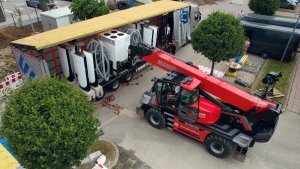
According to the @teslacharging account on X, these new units make installation faster, cheaper, and better. By using a foldable design, Tesla can now fit 16 Supercharger posts on a single truck — up from the previous 12 — significantly cutting down on the logistics costs of shipping pre-assembled hardware.

The Benefits of the Folding Unit (FU)
The introduction of the FU Supercharger is a direct upgrade to the pre-fabricated units Tesla has used for years. Max de Zegher, Tesla's Director of Charging, explained that these units "save 20%+ on cost, improve build quality, and deploy 2X faster.”
A major part of these savings comes from reducing on-site labor. With the new design, there is no more DC busbar connection required in the field, and remarkably, a Tesla service technician is no longer needed for commissioning. This means a site can be dropped into a parking lot, hooked up to power, and go live almost immediately. "It's why we're spending so much time improving our pre-assembled Supercharger units," de Zegher added, noting that this is just “Rev1” of this hardware, with Rev3 already slated to launch by next quarter.
A new 8-stall Supercharger that opened up in Columbia, SC, this week appears to be one of the first — if not the first — sites to use this new FU Supercharger hardware.

Accelerating the V4 Transition
This new deployment method is perfectly timed with Tesla’s total transition to V4 hardware. Earlier this month, Tesla assembled its final V3 Supercharger cabinet at Gigafactory New York, committing to installing only V4 stalls and cabinets moving forward.

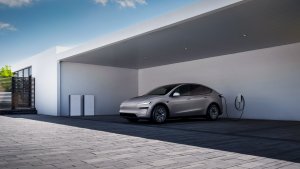
The V4 system is a massive step up from the previous generation. While a V3 cabinet could only power four stalls, a single V4 cabinet can handle eight. This matches the eight-post-per-unit setup of the new Folding Units perfectly. On the performance side, V4 hardware supports 500 kW peak charging speeds for 800V vehicles like the Cybertruck, while S3XY owners will continue to see the 250 kW rates they are used to.
Scaling for a Multi-Brand Future
Speeding up installations is more important than ever as Tesla continues opening its network to other brands, most recently adding Dodge, Jeep, and Fiat to the mix. To accommodate these new users, V4 stalls feature cables that are three feet longer, making it easier to reach charging ports located in different spots on non-Tesla vehicles.
By reducing the cost per stall — already the lowest in the industry at under $40,000 — Tesla is making it financially impossible for other charging networks to keep up. The ability to deploy 16 stalls per truck delivery ensures that the company can continue to lead as the gold standard for public charging.
As Tesla pushes toward "100% EV adoption," these incremental improvements in logistics and engineering are what allow the company to scale at a pace that traditional construction simply can't match. We expect to see these foldable units popping up at new locations globally before the end of the spring.