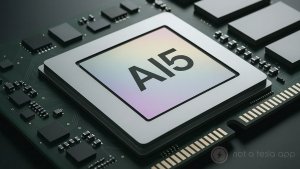
During the historic TERAFAB launch event in Austin, Elon Musk unveiled the silicon roadmap that will power the combined ambitions of Tesla, xAI, and SpaceX over the next decade. While the spotlight was understandably dominated by the AI5 and AI6 chips, which will serve as the unified brains for millions of Robotaxis and Optimus humanoids, many also noticed a third, highly specialized chip on the presentation slide and in the Lunar Mass Driver video: D3.
Standing for Dojo 3, the D3 chip is a pivot for Tesla’s custom silicon program. Rather than competing with NVIDIA on terrestrial supercomputer floors, the Dojo architecture has found its true, permanent calling: powering the vast majority of human compute in the vacuum of space.
The Pivot from Earth to Orbit
To understand the significance of D3, we have to look back at the turbulent history of the Dojo program. When Tesla first unveiled the D1 chip and the Dojo supercomputer, the goal was to build the ultimate Earth-bound video-training cluster for FSD. When the D2 chip later entered mass production, it continued that legacy with massive performance leaps.
However, as Tesla’s engineering teams increasingly unified the architectures for FSD and the Optimus robot under the upcoming AI5 and AI6 processors, and as xAI built out massive, GW-scale clusters using commercially available GPUs, many industry analysts speculated that the Dojo program was effectively dead.
The TERAFAB presentation proved that Dojo isn't dead; it has simply evolved to solve a much larger bottleneck. Earth is rapidly running out of electricity to power the AI revolution.
Currently, the entire planet only builds roughly 100 to 200 gigawatts of compute capacity per year, severely constrained by local power grids, cooling limitations, and physical real estate. To reach Musk’s ultimate goal of a terawatt, and eventually a petawatt of compute, the hardware must go off-world. Enter the D3.
Unconstrained by Earthly Limits
The D3 chip is different from AI5 or any terrestrial processor because it is engineered specifically for the hostile, yet liberating, environment of space.
When designing chips for Earth, engineers spend significant time and money managing heat and power dissipation. D3 throws those constraints out the window. Because space is an endless thermal sink and the chip will not be constrained by a fragile local power grid, D3 is designed to be a vastly higher-power chip that can safely run much hotter than any processor on Earth.
Plus, the D3 architecture is heavily radiation-hardened. Operating outside the protection of Earth's magnetic field exposes silicon to severe cosmic radiation, which can cause bit flips and catastrophic hardware failures in standard chips. D3 is optimized from the ground up to survive and thrive in this unforgiving environment.
The Economics of Space Data Centers
But why send the D3 into space in the first place? During the presentation, Musk made a staggering economic prediction: within a few years, it will actually be cheaper to launch chips into space than to build a traditional data center on the ground.
The secret lies in the synergy between the D3 chip and SpaceX's heavy-lift capabilities. D3 processors will be packed into massive, 100-kilowatt orbital server racks - the AI Sat Minis. Weighing roughly one ton each, these satellites will be deployed into orbit by Starship.
Once in space, the economics of running a D3 cluster become radically cheap. Because these satellites can be positioned to receive 24/7, uninterrupted sunlight, there is no need for heavy, expensive battery backups to keep the chips running. Furthermore, space-based solar arrays cost significantly less to manufacture than terrestrial solar panels, as they don't require heavy glass or thick aluminum framing to protect against wind, rain, and gravity.
Founding a Galactic Civilization
Ultimately, the D3 chip represents the critical bridge between Tesla's AI ambitions and SpaceX's interplanetary goals.
While AI6 will be the workhorse that navigates our cars and automates our physical labor via Optimus, the D3 chip will be the unseen backbone of the entire ecosystem. Operating silently in orbit, massive constellations of D3-powered AI Sat Minis will handle the unimaginably heavy data processing required to scale xAI's intelligence, power the Martian internet, and eventually guide humanity's push into deep space.