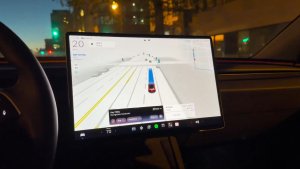
As Tesla rolls out Full Self-Driving (Supervised) v14.3 to early-access testers, a hidden safety feature has been discovered. In an effort to keep vehicles firmly planted on the road during inclement weather, the new software update actively restricts the available driving profiles when conditions deteriorate.
During rain FSD 14.3 locks you into chill or sloth. Standard, hurry, and mad Max are not available. pic.twitter.com/hm1G4ibgla
— Dirty Tesla (@DirtyTesLa) April 10, 2026
Locking Out Aggressive Modes
Historically, FSD has allowed drivers to choose how aggressively the vehicle navigates traffic, offering modes ranging from the highly conservative Chill to the assertive Mad Max. However, users running v14.3 have noticed that when the weather turns poor, the system now automatically locks the vehicle into either Chill or Sloth mode.
The more aggressive options, including Standard, Hurry, and Mad Max, become completely grayed out and unavailable until road conditions improve.
The Hydroplaning Trigger
After initial reports surfaced regarding these locked driving modes, Tesla engineer Yun-Ta Tsai took to social media to clarify the underlying logic. Tsai explained that the restriction is not simply triggered by the basic presence of rain or the activation of the windshield wipers.
It only does this when we detect a possibly hydroplaning surface. It’s more than just rain.
— Yun-Ta Tsai (@yunta_tsai) April 10, 2026
Instead, FSD evaluates the actual road surface. Tsai noted that the system only locks the driving modes when it specifically detects a "possibly hydroplaning surface." This means the safety lockout is designed to activate only when the vehicle calculates a tangible risk of losing traction due to standing water.
Real-World Drawbacks and False Positives
While dynamically restricting aggressive acceleration and lane changes in dangerous weather is undeniably a positive step for fleet safety, early testers are experiencing a few growing pains with the new protocol.
Some drivers have reported that the hydroplaning detection can be overly sensitive, triggering the lockout on mostly dry roads during very light drizzle. Additionally, forcing the vehicle into Chill or Sloth mode can create unintended traffic flow issues.
These highly conservative profiles often default to driving below the posted speed limit. When the system incorrectly assesses a damp road as a severe hydroplaning risk, the artificially slow speeds can frustrate surrounding drivers, frequently forcing the Tesla owner to disengage FSD and take over manually to maintain the flow of traffic.
As Tesla gathers more real-world data from the v14.3 rollout, the sensitivity of this hydroplaning detection will likely be fine-tuned to strike a better balance between absolute safety and practical daily driving.