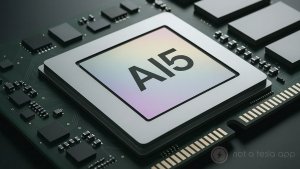
Tesla is moving at a breakneck pace in the semiconductor world, but its most powerful chip yet might not land in your driveway as soon as you hoped. Elon Musk officially announced on Wednesday that Tesla’s next-generation "AI5" chip has finished its design phase, also known as "taping out," marking a major milestone for the company’s internal hardware team.
In a post on X, Musk congratulated the Tesla AI chip design team on the achievement while teasing that "AI6, Dojo3 & other exciting chips" are already in the works. However, when asked if this new silicon would be heading into cars or robots, Musk clarified that the initial focus for AI5 will be "Optimus and our supercomputer clusters." He added that "AI4 is enough to achieve much better than human safety for FSD."
Optimus and our supercomputer clusters.
— Elon Musk (@elonmusk) April 15, 2026
AI4 is enough to achieve much better than human safety for FSD.
A 5x Leap in Raw Power
The technical specs for AI5 are staggering. Musk confirmed that a single AI5 unit has five times the useful compute of two AI4 chips. This massive performance jump is expected to free up Tesla’s engineers, giving them the breathing room to create much larger and more complex AI models without hitting the hardware ceiling.
Currently, Tesla engineers have to work around the memory limitations of the AI4 computer, optimizing software models specifically to fit onto the existing hardware. We recently learned that a 10-billion parameter model — originally intended for FSD v14 — has been pushed back to FSD v15, which is a ways away. AI5 will eventually solve these constraints, but it looks like the Optimus humanoid robot and Tesla’s training clusters are the priority for the first batches of silicon.
The Timeline for Tesla Vehicles
While Musk appears to be downplaying AI5 for cars right now, it is almost certain to become the standard for Tesla’s vehicle lineup eventually. Tesla has long touted AI5 as the key to comfortably unlocking "safer than human" autonomy, and the current pivot toward AI4 is likely a temporary measure to manage supply and manufacturing timelines.
Consumer vehicles aren’t expected to see AI5 integration until 2027, after Samsung and TSMC begin mass production. The Cybercab robotaxi, which is slated to enter volume production this month, is launching on AI4 hardware. However, it will likely be among the first products to receive a mid-cycle refresh with AI5 chips once they become available.
Beyond AI5: The 9-Month Cycle
Tesla is aiming for an aggressive nine-month development cycle for its silicon, putting it on par with the fastest-moving companies in the tech industry. Looking further out, the AI6 chip is already slated for a 2028 production start, with Samsung handling manufacturing exclusively in the U.S.
Meanwhile, the Dojo 3 (D3) chip is being optimized for a completely different environment: orbital data centers in space. By moving compute off-world, Tesla could bypass power grid constraints on Earth. It is a bold vision that shows Tesla is no longer just a car company; they are becoming a verticalized AI powerhouse. While your Model 3 might be "stuck" with AI4 for now, the sheer scale of compute power coming down the pipe is unlike anything the automotive industry has ever seen.