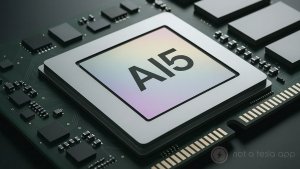
Elon Musk has officially announced that Tesla’s next-generation "AI5" chip has exited the tape-out stage, and it is a literal beast of a processor. In a post on X, Musk confirmed the design was ready while sharing that a single AI5 chip delivers roughly 5 times the useful compute power of the dual-SoC AI4 setup found in current Teslas.
While Musk is currently downplaying its arrival in consumer vehicles — noting that AI4 is already "enough to achieve much better than human safety" — this chip represents an architectural step-change. It appears that Tesla is finally moving away from the redundant dual-chip design of HW3 and HW4, suggesting a new level of confidence in the hardware’s reliability. By consolidating into a single-chip design, Tesla can maximize efficiency and raw power without the overhead of keeping two identical chips in sync.
The Memory Monster
While the compute leap is impressive, the real "monster" metric for AI5 is its memory. Musk has previously hinted at a 40x improvement in certain metrics, which aligns with rumors of a staggering increase in RAM. While the current AI4 computer relies on 16GB of RAM, Musk has previously teased that AI5 could feature roughly 9 times more memory, potentially reaching up to 144GB. We’ll have to wait and see just how much of that Tesla can realize, given the ongoing global memory shortage and sky-high LPDDR5 prices.
AI models are incredibly memory-hungry, and Tesla engineers are already hitting bottlenecks with AI4. This massive RAM upgrade will allow Tesla to run models that are, as Musk would say, orders of magnitude larger than what we see today. For context, the much larger 10-billion-parameter model originally intended for FSD v14 was pushed back to v15, likely to give engineers more time to optimize for current hardware. AI5 will effectively remove these "handcuffs," letting the software team build the massive neural networks they’ve been dreaming of.
Robots and Supercomputers First
In a pivot from his previous rhetoric, Musk recently said that consumer vehicles won't be the first to receive AI5. Instead, the initial batches of silicon are destined for the Optimus humanoid robot and Tesla's massive supercomputer clusters. This makes sense; Optimus requires high-density compute to navigate the physical world, and Tesla’s training clusters need every ounce of performance to process the billions of miles of fleet data.
The Cybercab robotaxi is still expected to launch with AI4 hardware after entering mass production this month, but it will almost certainly be the first vehicle to get an AI5 refresh once volume production ramps up in 2027. Consumer vehicles like the Model 3 and Model Y will likely follow that same timeline. Tesla is currently targeting an aggressive nine-month development cycle for its chips, with AI5 production split between Samsung in Texas and TSMC in Arizona.
The End of the Hardware Bottleneck
Tesla's journey from HW3 to AI5 has been a series of hard-fought lessons. Engineers are currently maxing out what is possible with distillation and model shrinking just to make FSD run smoothly on existing cars. AI5 represents the light at the end of that tunnel.
With 5x the raw compute power of two AI4 chips and much more RAM, AI5 could serve as the foundation for the "Unsupervised" era of FSD. While Tesla maintains that Unsupervised FSD is technically possible on AI4, it’s highly probable that we’ll see it perfected on AI5 first before being backported. By the time 2027 rolls around, the specialized AI silicon in your car might just be more powerful than the high-end gaming PC in your den.